There are things from your childhood that will stay with you your whole life, memories that sit deep inside your subconscious and are never forgotten, even if you cannot instantly recall them. Some of these memories may be significant — the death of a grand parent or some achievement at school — but some will be trifling. For me, one of the latter memories is the dark Gothic art work for Bally's pinball table, Centaur. I did not know the name of the table, only the backboard art, with the H.R. Gigar-esque design of the part demon, part motor cycle, wielding a battle axe and the leather-clad rock chick riding him. It scared me and made me think the people playing the table must be dark, malevolent types, but it fascinated me all the same. It was only when Farsight Studio's converted the table for their Pinball Arcade platform that my memories all clicked into place. As soon as I saw it I had to play it and I found that beyond the scary art is a brilliant pin. Since then I've played the table a lot, but I still find Paul Faris's art work a little creepy, so I had to make it my Halloween classic for 2014.
The stark, dingy art work of the backboard and sides carries over on to the playfield, which is one of the gloomiest ever made; everything is black, white and red. If you play on a table with dim or faulty bulbs, it can be quite difficult to see anything at all. Like many tables from the early 80s, Centaur has primitive synthesized sound that, although basic, only adds to its eerie atmosphere. As you play the table instructs you to "Destroy Centaur" and says the names of the table's various features as you enable them.
Key to success in Centaur are the table's O.R.B.S. drop targets, which can initiate multi-ball mode in a number of ways. Drop all four targets and you'll lock a ball for multi-ball. Drop the targets in order and you'll both lock a ball and trigger a multi-ball at the same time. To initiate the multi-ball you have to hit the captive ball in the chamber on the top left and knock down another series of drop targets, until eventually you hit the release target to launch the locked balls. However, it takes considerable skill to do this, which is why the table is such a beloved classic. Thankfully, that's not the only way to get multi-ball on Centaur and in fact it's possible to "lock" balls without ever having a ball go out of play, thanks to a clever trap-door launch mechanism under the shooter lane.
I used to think nudging was kinda cheating, but here it is encouraged in the game's design. There are small, rubber notches on the outlanes, which, if you rock the table just so, will bounce the ball back into play, preventing it from draining.
This table is too early for DMD, so it has 7-bit displays for the scores. This means that unlike later tables the amount of direction the player gets from the backboard is limited. Thankfully, as well as its famous synthesized voice commands, the game also makes clever use of colour-coding. with different coloured bulbs showing the player which targets trigger which features. For example, a green light in the top right hand corner indicates that the target behind can be used to reset the green drop targets below.
Playing it today, Centaur may look basic, with no ramps, multiple tiers or even spinners. However, its multifaceted multiball mechanism makes it every bit as rewarding as many more intricate-looking tables. The video below shows a beautifully restored Centaur table in action, which looks brighter than a normal table thanks to the LEDs that have been used to replace the original bulbs.
And this video, by the brilliant Todd Tuckey of TNT Amusements, explains the rules brilliantly.
I still vow to own a pinball table one day and while it's likely I'll opt for a newer, more reliable Stern, Jersey Jack or Heighway table, when it comes to classic pins, Centaur is very high on my want list.
And as a final note, if you're looking for more Halloween games, Pinball Arcade has recently added Phantom of the Opera and Bram Stoker's Dracula, to go along with Centaur and its other spooky tables, such as Haunted House, Gorgar, Class of 1812, Monster Bash and both Elvira tables.
At the beginning of Steven L. Kent's 'Ultimate History of Video Games' there is this quote by former CNN Computer Connection producer, Steven Baxter, which says:
"You can't say that video games grew out of pinball, but you can assume that video games wouldn't have happened without it. It's like bicycles and automobiles. One industry leads to the other and they exist side by side. But you had to have bicycles to one day have motor cars."
So when people point at Pong or even the oscilloscope game Tennis for Two, way back in 1958, as the origins of video games, they are missing out on this simple truth. With that in mind here is Arcade Throwback's brief history of pinball, the true origin of arcade gaming and the huge home and mobile gaming industry we know today.
Bagatelle and the beginning of pinball
Being essentially mechanical in nature, pin games have been around for centuries, all the way back to Bagatelle tables in the 15th century, like the one below.
An example of a Bagatelle table.
Even without flippers, flashing lights, ramps or digitised score[board]s, it's easy to see how this could be the origin of pinball, although it's actually a form of billiards. Some versions of Bagatelle also included wooden pins, which had to be avoided in order to get the balls into the cups. A few centuries later, a variant called billiard Japonais (Japanese billiards) replaced the cues with a plunger and the free-standing wooden pins with fixed, metal pins (basically nails). Billiard Japonais went on to inspire a few other games, including pachinko and something that got us a whole lot closer to the pinball we know today, but for that we need to fast forward to the 1930s.
Baffle Ball and Ballyhoo
In 1931 David Gottlieb invented a variation of billiard Japonais which he called Baffle Ball. In this new game players had to rock the table to get the balls into the desired hole — a technique that would later become known as nudging. Compare the photo of Baffle Ball (below) to the photo of the Bagatelle table above and the resemblance is undeniable.
Gottlieb's first pin game.
The success of Gottlieb's game meant it wasn't long before others started to create their own pin games. Among them was Ray Moloney, owner of Lion Manufacturing and creator of Ballyhoo. Moloney's game was so successful, he decided to change his company name to Bally and a future legend of pinball was born.
By all accounts, Gottlieb had a knack for balancing skill and challenge to make fun games, but around the same time another big name for pinball emerged. His name was Harry Williams and he was a Standford-educated engineer, which meant he knew how to create complex mechanisms for his games. In 1933 he created Contact, the world's first electric pinball game. Previously, once a ball landed in a scoring pocket, it had to be retrieved by hand (either by picking it out of the pocket or from a collection tray at the bottom). Contact's scoring pockets had electrically-powered contacts (hence the name) that knocked the ball back into play, allowing the game to continue uninterrupted. Unfortunately, it is around this time that problems started to occur for pinball and pin games, all of which linked back to early gambling machines called pay-outs, which looked a little like pinball machines. It seemed some people in authority couldn't (or wouldn't) see the difference.
Pinball outlawed
A pinball machine being demolished after a raid
By the 1940s, pinball was outlawed in many parts of America, as it was thought to be a form of gambling with links to organised crime. It was also thought to be a bad influence on America's impressionable youth, who would waste their time and money on the games. In 1942, New York Mayor, Fiorello La Guardia, authorised raids on pinball establishments and issued arrest warrants for their owners. And what happens when the authorities try to ban something? It goes underground, develops an almost mythical reputation and becomes more popular than ever. The manufacturing, innovation and popularity of pinball continued unabated, with Chicago becoming the capital of pinball production, despite it also being illegal there. It was in the windy city that Gottlieb, Bally and Williams were all based. Gottlieb in particular battled to legitimise his games. He knew the key would be to prove pinball was more than a game of chance, which meant his games needed to demonstrate the need for skill.
Putting the flip into pinball
In 1947, Harry Mabs, one of Gottlieb's engineers, added spring-powered "flipper bumpers" to a game called Humpty Dumpty. The flipper bumpers were used to knock the ball back into play, in exactly the same way as modern pinball, which added weight to Gottlieb's argument that pinball needed skill to play. As the video below shows, Mabs' flipper bumpers were not located at the bottom and there were more than two of them - in fact, there were six:
Flippers revolutionised pinball, to the point that in France, pinball tables are known as le flipper. Gottlieb's competitors got in on the act and for the next few years all pin games had six flippers in a similar arrangement to Humpty Dumpty. Eventually having two flippers at the bottom of the table became the norm, but it was actually for reasons of thrift, rather than design choice. The man to thank for that was Steve Kordek, a designer at a company called Genco. He was under instructions to save money in his designs, so he reduced the number of flippers to two and in order to make them as useful as possible, he put them at the very bottom of the table. The result was a table called Triple Action. It's still not quite the pinball we know today, as the flippers still pivoted from the middle of the table, rather than the outside edges (a la Humpty Dumpty), but it was still a major step forwards.
Two flippers at the bottom. The start of something big.
The introduction of flippers proved pinball needed skill to play and by the mid-70s most US cities lifted the ban. This is what Gizomodo has to say about the day the ban on pinball was lifted in New York:
"In May of 1976 in New York City, Roger Sharpe watched nervously as city council members piled into a Manhattan courtroom. Reporters and camera operators had already begun setting up, eagerly anticipating the proceedings ahead. Roger, a young magazine writer for GQ and the New York Times among others, did not expect this kind of attention. He knew lots of people, from bowling-alley-hanging teens to the Music & Amusement Association, were depending on him, but didn’t realize the whole country would be watching. Roger had been selected for this particular task not only for his knowledge and expertise, but for his legendary hand-eye coordination. He was there to prove that this was a game of skill, not chance. He was there to overturn the ban. He was there to save the game of pinball."
Despite this, bans on under 18s playing pinball remained in various parts of the US up until the 2000s and pinball was still illegal in the town of Beacon, NY, up until 2010 (and may still be). I cannot find anything to suggest pinball was banned in the UK, but our laws did influence the industry. In 1991, UK laws on chance games saw the introduction of the ball saver feature. This is why modern pinball tables will often give you a free ball if, straight after being launched, it drops out the bottom without the player hitting it.
Dark heart of the arcade
For decades, the pinball machine was a symbol of delinquency and rebellion, like rock 'n' roll and motorcycles. Even up until the 1980s, antagonists in movies were sometimes seen playing pinball, as if to imply that was part of their dangerous personalities. YouTuber Bumper McBaulogh (I believe that's his actual real name) has made a series of videos called Pinball in the Movies, which shows clips of films that feature pinball, with no voice over or any other narrative about the nature of the machines' representation. In each case, the machines are in some way linked to immoral, unscrupulous or outright illegal activities. You can check out Bumper's channel here. Perhaps the most graphic example of a pinball table being associated with dangerous, even evil people, was in the 1988 Jonathan Kaplan film, The Accused. If you haven't heard of the film, it features a grotesque sequence in which a drunk Jodie Foster is held down and gang raped on a re-branded Bally Space Invaders table (called Slamdunk in the film, which feels like some kind of tasteless pun, given the context).
From my memories as a child, pinball tables seemed to attract a more sinister crowd than the likes of Frogger or even Mortal Kombat. In the arcades I visited, pinball machines were separate from the video games and were often located with the one-armed bandits and fruit machines (that link to gambling still rearing its ugly head again). Many of the tables I encountered in smoky city centre arcades were based on horror movies or some other Gothic theme. Tables such as Tales from the Crypt, Centaur,Freddy: A Nightmare on Elm Street, Haunted House, Gorgar and Spooky all instantly spring to mind.
But that's enough about the negative side of pinball.
Innovations and the golden age of pinball
Harry Williams' electric contacts began the steady technological progress of pinball. From the 40s up to the 70s electromechanical (EM for short) machines ruled pinball. As the name suggests, these used electrically-powered mechanisms, such as relays, to control things like sink hole returns, slingshots, bumpers and even scoreboards. These machines had very limited sound, usually nothing more than a bell and the clatter of the relays, which even today are synonymous with pinball.
An EM scoreboard from a Williams Go Go Pinball machine
In the 70s, consumer electronics blew up in a big way, with the first wave of electronic record players, video cameras and home computers emerging from America and Japan. It was in 1976 that Micro Games released the first solid state pinball machine, Spirit of '76. Gone were the relays, now the gameplay and scoring was controlled by electronic circuits. Along with the circuit boards came LED scoreboards, sound effects, synthesized music and eventually voices, which could issue instructions (or sometimes taunts) to the player. It was the beginning of the golden age of pinball.
Spirit of '76, apparently the first electronic pinball machine.
From 1977 onwards solid state machines ruled the pinball scene and by the end of the 80s, pinball was more popular than ever, but there was another, even bigger change on the horizon.
In 1991, Data East introduced a new kind of score board into a machine called Checkpoint. This new technology used an array of orange LEDs to create a dot matrix display (or DMD for short). It was the biggest innovation in pinball since Harry Mabs added flippers to Humpty Dumpty. Not only did DMDs allow pinball manufacturers to display graphics in their games, they could also give the player detailed instructions and even provide stories for the player to follow. This elevated the gameplay above simply hitting targets, bumpers and ramps in order to get high scores, now players could aim to trigger the next chapter in an interactive blend of story, skill game and puzzle.
Decline of the industry
Sadly, as arcades diminished, so too did the demand for pinball tables. Despite new innovations and attempts to attract new players, pinball machines were dragged under with the fall in popularity of video arcade games. Below is Bally's promotional video the classic Cirqus Voltaire from 1997. This video includesa company briefing with a sales chart clearly showing the decline in pinball's popularity over the past few years.
This decline was not just a bump in the road, but the edge of a cliff for pinball. By the end of the millennium, most of the great manufacturershad gone out of business.
Here's a list of casualties:
Italian manufacturer, Zaccaria, stopped making pin games in 1988.
Data East was bought by Sega in 1994 and renamed "Sega Pinball".
Midway sold Bally to the Hilton Hotel group in 1995, but made no more pin games.
1996 saw the end of Gottlieb, Alvin G & Co. and Capcom's pinball division.
Williams went under in 1999, despite their attempts to revitalise interest in pin games with their hybrid "Pinball 2000" machines.
In 1999 Sega sold their pinball division (which was formerly Data East's) to the then President of Sega Pinball, Gary Stern who called his new company "Stern Pinball".
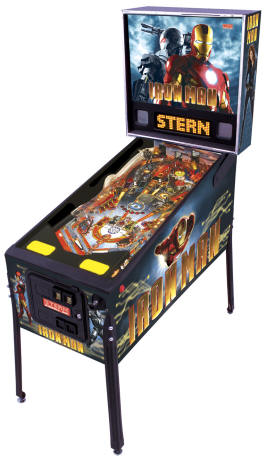
For around a decade, Stern was the only major pinball manufacturer left in the world. They survived by making machines based on bands, films and TV shows; Pirates of the Caribbean, AC/DC, Lord of the Rings, Sopranos, CSI, Terminator 3, Spider-man, Metallica, Avatar, Tron Legacy, The Simpsons, Batman, Indiana Jones and Iron Man all got a pinball machine, thanks to Stern.
The power of nostalgia
Thankfully, a deep-rooted love for pinball means there are plenty of people who will fight tooth and nail to see the industry commemorated and survive. As well as countless websites celebrating pinball, in 2009 the Las Vegas Pinball Collectors Club got together and opened the Pinball Hall of Fame. You can even do a Google Street View tour of the inside of the museum here. It is, quite frankly, incredible.
Inside the Pinball Hall of Fame, Las Vegas
Video pinball and emulation
For generations of pinball fans, they've only been able to enjoy the hobby because of a combination of original video pinball games and pinball emulators. Unlike arcade ROMs, which just need be ripped from the chips and emulated on MAME, Kayaks or whatever, digitising a pinball table accurately is an expensive and painstaking process. There is a community of people out there trying to do just that, with emulators such as PinMAME, Visual Pinball and Future Pinball, but like all emulation it is illegal - the scarcity of actual pinball machines does not get you out of that.
Thank God then for the mayor of Big Bear Lake, Jay Obernolte, whose video game company Farsight Studios, has been creating digital versions of classic tables from Gottlieb, Williams, Bally and Stern for the past decade. Initially they launched manufacturer-specific games with a dozen or so tables in them, but in 2012 they launched The Pinball Arcade. This all-encompassing, ever expanding pinball emulator features almost 50 classic tables and is available on pretty much every platform going.
Following in Farsight's footsteps, there is also Zaccaria Pinball by ASK Homework, which, as the name suggests, emulates Zaccaria tables (around two dozen of them). Unlike The Pinball Arcade, Zaccaria Pinball is only available on iOS and by all accounts it's a little buggy in comparison). But Zaccaria's machines are even harder to find in the real world than those from Bally, Williams, Gottlieb, Data East or any of the other big manufacturers, so let's hope it improves and becomes available on other platforms.
If you're willing to look outside of the classic tables, there is also Pinball FX 2 (known as Zen Pinball on some platforms), by Zen Studios. Also available on every platform going, Zen started out making original tables, such as Nightmare Mansion, Secrets of the Deep and Tesla. For the past couple of years they have gone the way of Stern and started making licenced tables, based on Marvel comics, Star Wars, the FIFA football association and other video games (the Plants Vs Zombies table is a riot).
One of many Star Wars-themed tables in Pinball FX 2/Zen Pinball
Sony also got in on the video pinball scene, with not one, but two games, both featuring licenced tables. For the original PSP there was Pinball Heroes. Released in 2010, it featured tables based on PlayStation 3 games such as Uncharted, Fat Princess, Pain and Everybody's Golf. More recently they released Pinball Rocks for iOS and Android. This rock and metal themed game features tables based bands such as AC/DC, Slayer, Alice in Chains and Bullet for my Valentine. Even movie studio MGM have produced a video pinball game - War Pinball, which features tables from based on movies such as Navy Seals, Missing in Action and (somewhat bizarrely) Platoon.
Pinball purists tend to scoff at video pinball, emulated or otherwise, criticising their physics and unrealistic features. Zen's games in particular include features that could not be done mechanically, such as figures that jump into the playfield to strike the ball and space ships flying around the table. While this annoys me a little, Zen's tables are still fun and challenging. More importantly, for the past decade these video pinball games are all most of us have had to slake our thirst for the silver ball.
The future of pin games
Despite the grim state of the industry a few years ago, things are starting to look up. In 2010, New Jersey-born business man Jack Guarnieri started up a new pinball manufacturer called Jersey Jack. Their début table is based on the MGM classic Wizard of Oz from 1939 and set pinball forums alight when they first announced the game. As this video shows, Jersey Jack have put their heart and soul into this table. It takes classic pinball elements and combines it with modern technology, like a 3D LCD back glass.
Then, in 2012, Andrew Heighway started up the UK's first major pinball manufacturer, Heighway Pinball. Seemingly coming out of nowhere, Heighway has some major industry names on-board, including artist Doug Watson (Attack from Mars, The Getaway: High Speed II, Terminator 2, Black Knight and Black Knight 2000)and designer Dennis Nordman (Elvira and the Party Monsters, Scared Stiff, Dr Dude, White Water (a person favourite). In an interview with the BBC, Andrew Heighway said, "There's been a huge boom in pinball smartphone and console games over the last
few years. ...thanks to these video games, there are plenty of kids that have been primed for
the real thing." That is a very interesting quote indeed.
Full Throttle's playfield with an LCD display in the middle
Jersey Jack and Heighway Pinball may have grabbed the headlines in recent years, but they aren't the only ones making new machines. Nordman (again) teamed up with pinball artist Greg Freres (Monster Bash, Strange Science, Star Trek: The Next Generation, Revenge from Mars and Medieval Madness) to create WhizBang Pinball. Together they made a limited number of bespoke pinball machines from other donor machines.
Nordman also teamed up with a new company called Multimorphic to help them create Lexy Lightspeed - Galaxy Girl, a brand new machine built on Multimorphic's P3 platform and due for release at the end of the year. Here's Lexy in action:
The beauty of the P3 system is that its designed to play more than one game on a single table, thanks to its large LCD play field. So as well as Lexy Lightspeed, the table will also play Cosmic Cart Racing when it's finished.I like the idea, but I can't help feeling it falls between two stools, being neither a fully mechanical pinball table, nor a "skies the limit" video pinball, like the sort of thing Zen Studios have been delivering. Rather than being the best of both worlds, it seems like a dilution of both technologies - but hey, at least they're trying.
I'm particularly excited to see what comes out of Heighway, not least because they are the UK's first major pinball manufacturer, but also because more than any other company out there, Heighway are trying to push the industry forward and take advantage of new technology, without compromising the spirit of traditional pinball. Not only that, but they are trying to build pinball machines smarter, replacing unreliable mechanical parts with sensors and other, most robust devices. They are also offering modular tables, making it easier for operators to swap and change faulty parts. The video below shows an early prototype for Heighway's upcoming Circe's Animal House. On the right you can see a blank "white board" version of the table playing, but on the left, you can see what at first appears to be graphics projected on to the surface of another blank table, but which is in fact a transparent LCD display. This allows Heighway to display effects, scores, characters, anything they like, whilst maintaining an entirely traditional playfield.
So with Stern providing the backbone of the industry, The Pinball Arcade reminding a new generation what's so great about pinball, and Jersey Jack and Heighway leading the charge for new developments, it appears pinball is in a better state now than it was 15 years ago. All we need now is for pubs, bowling alleys, seaside arcades and restaurants to start stocking these new machines and we're in business.
On the whole, games on home platforms are made to be completed, while arcade games were not. There is a simple reason for this: money! The quicker you finish your game on your Gameboy or Megadrive or PlayStation or XBO, the sooner you'll go out and buy another; equally, the quicker an arcade game depletes your lives to zero, the sooner you'll jam in another 20p. There are exceptions to this rule in both camps (something anyone who's played From Software's Souls games on modern consoles can testify to), but I finish most games I buy, while I've only ever finished a few arcade games. However, even among the hard-as-nails world of arcade games, there are those that are famous (or infamous) for being truly hardcore. And the game that was hailed as the one that kick started the trend was Williams' extreme shoot 'em up Defender. Before I talk about how and why Defender was so tough, I want to give you a quick history lesson. Released in 1980, Defender was the first game to be developed by pinball developer Eugene Jarvis. Despite his inexperience, Jarvis created a master piece that went on to be Williams' most successful game. Jarvis himself is now a legend in the industry, responsible for some of the all time classics like Robotron and Smash TV. His current company, Raw Thrills, is one of the few video arcade game manufacturer's left today.
Now for Defender. It's highly unlikely you haven't played Defender at this point, but for those who haven't here's a quick summary. It's a horizontally scrolling shoot 'em up, with wrap-around levels, where you have to protect the humanoids wandering around the terrain from the invading alien forces. Given a chance, these aliens will pick up a humanoid and take them to the top of the screen, where they turn into fast-moving mutants. Preventing you from doing your job there are lots of different alien types and with each wave new types are introduced. To help you do your job you have a laser gun, a hyperspace and a smart bomb, the latter of which had limited capacity.
That all sounds fairly humdrum, but Defender is far from humdrum -- in fact playing it is downright stressful. If you play it on a home platform there are several major factors contributing to this sense of duress.
There are lots of aliens and multi abductions happening at any one time.
Everything about the game is fast! You're fast, the aliens are fast (especially the zombies) and the abductions are fast.
For every humanoid abducted, the resulting mutants made it harder.
Saving a humanoid didn't just mean killing the abducting alien, you also had to catch the humanoid mid-fall, otherwise they were pulverised on the terrain and turned into Pulp.
Failing to protect the humanoids caused all remaining Lander aliens to turn into Mutants, so if you were bad at the game, it only got harder!
If you ever played the game in the arcade there was another factor: its non-conventional controls, as can be seen in the image below:
As you can see from the arrows above and below the joystick, it only goes up and down. To go forwards you need to use the thrust button on the right, between the fire and smart bomb buttons. That's all fine, but it gets tricky when it comes to using reverse, which is next to the joystick. A skilled player could possibly hit this with the side of their left thumb, but it's quite unnatural. The biggest problem of all is with the hyperspace button, which is in the middle of the control panel. This meant you had to let go with one of your hands to use a power that was already fraught with danger (Eugene Jarvis himself is on record as saying using hyperspace had a 25% chance of getting you killed). If you translated that to a modern Xbox or PlayStation controller controller, it would be like having reverse on the Back/Select button and hyperspace on a different controller sat on your lap!
Let's look at Defender in action:
Sadly, although Defender was available on the XBLA marketplace, when Midway (who distributed the game in the West) went under, it was pulled. Fear not, its legacy lives on in countless clones. For Xbox 360 owners I would recommend Orbitron Revolution on the Xbox Live Indie Games marketplace (which I reviewed here). Also on both XBLIG and Steam there's the cute and hilarious Aqua Kitty: Milk Mine Defender. And for those hip kids with the next gen consoles, PlayStation 4 owners get the most recent homage, RESOGUN for free with a PlayStation Plus account. I covered RESOGUN in brief here a few months ago.
In celebration of The Pinball Arcade's first anniversary, here are our top 10 pin games, many of which I've only been able to play because of Far Sight's simulator.
Star Wars Episode 1
I'm going to start with one one of the few in this list I can remember playing and it's mainly because of the special tricks it pulls, such as the light sabre that lights up during the game and the holographic back screen, which allows you to blast droids with the ball. This technology was coined "Pinball 2000" by Williams and was an attempt to re-vitalise the floundering company. The objective of the game was to become a Jedi spirit (whatever that is), which means ascending the ranks of the Jedi and eventually battling Darth Maul. It says a lot about a film when the pinball table is a more memory experience.
Black Hole
Gottlieb's Black Hole is former classic of the month, so it's hardly surprising it also made it to my top 10. Like video games, atmosphere can carry pinball tables a long way and Black Hole's gaunt sound effects and simple layout are very atmospheric. It's tough to get the multi-ball mode to activate on this one, but when you do it's actually possible to have balls on both the main playfield and the inverted lower table; managing balls on both playfields, especially when the balls drop out of the top on the lower field, is only for the true pros.
White Water
If you like tables with lots of ramps, you'll love White Water. In fact, when I saw this table in a bowling alley back in the 90s, it was precisely because of its rapids-themed ramps that I started to play it. The object of the table was to make your way down the river rapids to Wet Willy's shack, encountering dangerous ravines, dark caves and even a yeti along the way.
Taxi
For me, personality also goes a long way when it comes to pinball tables and William's Taxi has personality in spades. The object of the table is to pick up and drop off its colourful cast of passengers, which includes Mikhail Gorbachev, Marilyn Monroe, Santa Claus, Dracula and Pin*Bot (although I have no idea how a planet-sized robot is supposed to get into a Crown Victoria). It still makes me smile hearing Pin*Bot saying, "Taxi, taxi, taxi" in his robotic voice. The looping ramps, which cross over in the middle also help to give this table a real sense of pace.
The Machine: Bride of Pin*Bot
Talking of Pin*Bot, William's trilogy are true legends of pinball, but when I decided to only include one of the series in this list I had to go with the first lady of pinball, The Machine. Not only did The Machine feature the pinball eyes of its predecessor, players also had to shoot their ball into her mouth to give her speech (which is a little counter intuitive). With each stage of The Machine's unique ball-locking mechanism her whole face rotates. Once she has balls in her mouth (ahem) and eyes, the multi-ball mode kicks in and you can rack up a serious score. I don't have any tattoos, but if I got one, I reckon it would be of this giant, sexy metallic lady.
Big Shot
Originally released in 1973 (when pinball was actually still illegal in New York City), Big Shot is the oldest table in our list. It's also the only electro-magnetic (EM) table in this list, but I love how deceptively challenging this table is. At first glance is looks pretty basic, but lighting all 14 of its drop targets with a single ball is surprisingly tough. There are few purer tests of pinball skill than to light them in order. I certainly can't do it.
Space Shuttle
A lot of the tables in this list are historically significant because of features they introduced to pin games, but Williams' Space Shuttle from 1984 is significant because it not only rescued the struggling Williams company, it also helped with the pinball resurgence that lead to so many great tables in the 1990s. As much as anything, for me it's the sounds this table makes that sends me into a nostalgic swoon. This is before digitised background music, so there's no rousing patriotic score or epic sci-fi theme, just a whole lot of awesome buzzes and beeps that wouldn't be out of place in Defender.
Theatre of Magic
Harking back to the days when magicians like David Copperfield, Siegfried and Roy and Lance Burton were master entertainers, Theatre of Magic really captures the feel of those big, complicated and above all extravagant tricks. As your score goes up the sense of the stakes also escalating is palpable. Among this table's many tricks are the rotating magic trunk, which can make balls disappear, the spirit ring and deadly tiger saw. All of which would look perfectly at home in a Las Vegas stage show.
Attack from Mars
This is one of my absolute favourites. Pinball games are famous for their crazy highscores, but Attack from Mars takes it to the extreme. Within seconds of playing even a newbie can rack a score of a few hundred million. As an experiment, I once played a game where I did not press a single flipper, I just launched the ball and let it drop and I still scored 192,000,000! It's a really good beginners table, because of its relatively simple rule set and its open playfield, which helps players to keep track of the action. Just don't be too disappointed when you go back to a different table and find you can only score a tenth of the score you got on this.
Tales of Arabian Nights
Based on the classic saga 'One Thousand and One Nights', this is another table with bags of personality. The objective is to rescue the princess from the demonic genie. Along the way players will be collecting gems, visiting a bazaar, flying a magic carpet and spinning Aladdin's lamp in the middle. I also love tables with great lighting and this table certainly has that. After each ball out, the gems you've collected disappear in time to the music, then with a final flourish from the oud, the whole table briefly illuminates. It looks beautiful. Also, if you haven't tried The Pinball Arcade on your Android or iPhone, this table is free with the basic version.
Choosing the first nine tables for this list was fairly easy, but choosing my final table was tough. The Pinball Arcade really showcases the best the pin games have to offer from the last 50 years and narrowing it down to 10 has been as hard, if not harder, than any of my other top 10s. In the end it was down to Tales of Arabian Nights, Cirqus Voltaire, Black Knight, Centaur and Funhouse. In the end, I had to go with the tables I played the most, which is why three of Pinball Arcade's launch tables are in this list.
It's a scorching summer here in the UK, so it seemed like the perfect time to talk about Arcade Throwback's top 10 sports games.
Track & Field/Hyper Sports
Here I go, starting the show with a show stopper! Konami's Track & Field series is legendary and there are more games in the series than most people remember. In 1984, a year after Track & Field, there was Hyper Sports, which is the first one I played. Then there was Konami '88, International Track & Field (1996) and Negano Winter Olympics '98, as well as numerous spin-offs on home consoles. For most people, myself included, it's those first two games, that kick started the whole button mashing sports genre, that really stay with us.
Tecmo World Cup '90
There were no football fans in my family, so first time I got into the beautiful game was during Italia '90, when I was 15. And what England fan didn't caught up in the moment when Paul "Gazza" Gascoigne's emotions got the better of him during our semi-final game against Germany? Even my mum watched it! Anyway, the football game to play that summer was Tecmo's World Cup '90. The simple controls made for a fast paced game that anyone could pick up and play and it remains one of my favourite video game interpretations of the sport.
F1 Grand Prix
Video System Co. Ltd's F1 Grand Prix could have gone in my top 10 driving games, but as one of the few properly licenced arcade racers I could remember, I thought I'd save this excellent top-down racer for the sports list. The game features all the teams and drivers from the early 90s, including such legends as Nigel Mansell, Jean Alesi, Nelson Piquet, Alain Prost and of course Ayrton Senna, all beautifully drawn and instantly recognisable. And while F1 begs to be made into simulators as opposed to arcade games, the top-down perspective works brilliantly, like a helicopter cam, letting you get a birds-eye view of all the jostling for position.
Side Pocket
If there was one sport that was on the telly in my house as a kid, it was snooker. I can't remember any snooker games in the arcades, but there were a few pool games, many of which came from Data East, including the dubious Pool Gal series. However, Side Pocket is the game I remember from the arcades I visited. With its top-down view, the mechanics were greatly simplified, but as always that suited the arcade.
Punch-Out!!
Nintendo's Punch-Out!! is perhaps better known for the NES and Super NES versions, but it did start out in the arcade in 1984. I remember it being a technically impressive game for the time, with the player's green-haired character (later known as Little Mac) appearing as a transparent wireframe model, so that you could get a better view of your opponent. And what a cast of characters they were! Glass Joe, Piston Hurricane, Dragon Chan, they were all brilliantly drawn and full of personality. The simply controls provided enough variety that you didn't just mash the buttons and the opponents' combinations of attacks, blocks and feints kept you on your toes. Nintendo resurrected the franchise in 2009 on the Wii and it's a brilliant update of the game.
Wind Jammers
You can look at SNK's Wind Jammers one of two ways: either you can disregard it because its a made-up sport or you can play it and enjoy one of the best one-on-one video games ever! The premise is simple, mix a little tennis and squash, but played with frisbees and add in special movies that wouldn't look out of place in a King of Fighters game. This is definitely one of those games that's easy to pick up, but very hard to master. Doing the special's is easy enough, but countering your opponent's specials and send them back at him with deadly force is much harder and also much more satifying.
Pigskin 621AD
Okay, if you thought I was pushing my luck with WWF Super Stars, you'll think I'm way over the line with Pigskin 621AD, but you won't deny it's a riot to play!This crazy medieval version of American football is almost as much a beat 'em up as a sports game. The field is also full of traps, like ponds, muddy puddles and boulders, which prevent you from zig-zagging wildly down the field in an attempt to avoid being clobbered by a mace-wielding warrior-jock. Unlike many other football games, you only control one player, the team captain, Thor Akenbak, but you can control the tactics (in a basic way) of your team mates by pressing the red button. When the player's team is in possession of the ball you can swap between "Block" and "Scatter", and when your opponents have the ball you can swap between "Get Ball" and "Man-to-Man". In either situation you can also set your team to free-for-all by selecting "Bad Attitude" — assuming you have enough time to think that far ahead in all the chaos!
Hit the Ice
Ice hockey is fast and frequently violent and so it's perfect for translation to video game. Few versions of the sport are as manic as Taito and William's Hit the Ice. Take control of a goalie and one member of either the Reds or the Blues, then skate, pass, shoot and, if need be, punch your way up the rink to score a slot shot. There are plenty of quite serious ice hockey games out there, but Hit the Ice is a bit like Pigskin in that it takes neither itself nor the sport it's based on too seriously. The result is a game that's full of comedic violence, like hitting your opponents in the head with the puck and making them see stars.
Virtua Tennis
When it comes to tennis, us Brits have never had so much to celebrate, with Andy Murray winning just about every grand slam he enters and several young stars, like Laura Robson, doing us proud as well. For gamers, there is no finer tennis game than Sega's Virtua Tennis series, which was developed for their Naomi system (which shared its guts with the Dreamcast console). The game manages to be both accessible and authentic in equal measure, allowing players to feel like they could take on the grass courts of Wimbledon as well.
Neo Turf Masters
All the other games in this list are based on fast, action-oriented sports, but Nazca's Neo Turf Masters for the SNK Neo Geo masterfully adapts the sedentary pace of golf to the rapid-fire world of arcade gaming, without sacrificing the core elements of the sport. For lives you get a strict stroke limit, meaning that you can only progress if you can stay under par, meaning you can be facing the game over screen as quickly in this game as any other in this list. And thank God for one of my school mates showing me Microprose Golf on the Commodore Amiga back in the early '90s, because otherwise I might have totally overlooked this gem, which remains one of my all time favourite arcade games.
Few people would refute that Williams' 1980 side-scrolling shoot 'em up, Defender, is one of the all-time classic arcade games, but it's easy to forget the following year Williams brought out a sequel. Known as Defender II, Defender Stargate or just Stargate, it was developed by Vid Kids, a small 3rd party studio formed by Eugene Jarvis and Larry DeMar, both of whom worked on the original. And eagle-eyed Arcade Throwback followers may have even noticed it on the banner of our Facebook page and Twitter account, so this month it's our classic in focus.
Gameplay is much the same as the original, except things get busy much more quickly, with a greater variety of enemies out to get you from the very first level. Thankfully your ship has a few more tools at its disposal this time, with the inclusion of the Invisio units, which allows you to turn invisible (and therefore evade hunters) while you keep the button held down. There are also the stargate themselves. These square portals are dotted throughout the landscape and effectively work like a fixed and more predictable hyperspace, allowing you to now only avoid danger but also deal with snatchers on the far side of the level.
Whether you can remember this sequel or not (I can't), one thing remains from its predecessor: IT'S ROCK HARD! To alleviate some of the difficult Vid Kidz added the option to pay extra at the beginning to get more lives, bombs, hyperspace jumps and Inviso units, but you'll still struggle to clear more than the first few levels.
So why is it so few of us can remember this game? It plays well enough and in many ways it's a better game than Defender -- it certainly tries harder to keep the player going. I suspect the answer is in my introduction: Defender is in the absolute top tier of arcade classics; the reputation it has the the respect fans have for it is up there with the likes of Pac-Man, Space Invaders and Donkey Kong. Quite simply, the original overshadowed it.
Let's be honest though, most people fell out of love with George Lucas's meandering sci-fi epic when he started to ret con the originals to fit the contrived story of the lacklustre prequels. However, with Disney recently buying the rights to all things Lucas and getting JJ "Lost" Abrhams on-board to make Episode VII over the next couple of years, Star Wars isn't going to go away any time soon and may even get good again.
Why do I mention this? Well, not only is today today Star Wars day, but this year is the 30th anniversary of Star Wars arcade video games, so I thought I would do a brief history of Star Wars arcade games, starting with one of the most iconic arcade games of all time.
Star Wars
Manufacturer:
Atari
Developer:
Atari
Genre:
Rail shooter
Year:
1983
What better sequence from the original Star Wars film to use for the basis of an arcade game than the seminal Death Star attack run? And that is precisely what Atari did with this magnificent vector graphics rail shooter. The multi-coloured vector graphics may have been incongruous with the film, but they still managed to be incredibly evocative. The game appeared around the same time as another first person vector graphics space game, Elite, for the BBC Micro B. Just like Elite, the way Star Wars looked and moved was closer to "real" space flight than anything else out there. Add in the beautiful cockpit cabinet with the flight stick controls and the digitised voice of Alec Guinness telling you, "The Force will be with you ... always" and Star Wars everyone were in sci-fi heaven.
Star Wars: Return of the Jedi
Manufacturer:
Atari
Developer:
Atari
Genre:
Shoot 'em up
Year:
1984
A year after the first Star Wars game and the last Star Wars movie in the trilogy, Atari switched from vector graphics to sprites and an fixed isometric view for Return of the Jedi. Like latter half of the film, the game switched between the battle on Endor and the battle in space to take down the half-built Death Star (2). The Endor levels consisted of racing through the forest on speeders and blasting up rolling logs and eventually the shield generator in an AT-ST. The space levels put you in control of the Millenium Falcon during the attack run on the Death Star, then the escape. The final level has you swapping between both scenes every few seconds, which is simultaneously exciting and disorientating. Like their first game, Atari filled RotJ with digitised voices and also added a few pixellated cut scenes for good measure.
The video below shows a complete play through, although watching the game from beginning to end will give you a frequent sense of deja vu.
Star Wars: The Empire Strikes Back
Manufacturer:
Atari
Developer:
Atari
Genre:
Rail shooter
Year:
1985
No, I'm not losing it, the game of Empire Strikes Back may have looked like the original Star Wars game, but wasn't released until a year after Return of the Jedi. The game also used the same vector graphics and cabinet as the original game. The reason for this was simple, Empire was not a full game, but a conversion kit for the original, which included a new daughter board, a new marquee and a decal for the yoke. In terms of game play, it is very similar to the first game, as you might expect. Instead of doing the attack run on the Death Star in an X-Wing, you alternate between flying a T-47 airspeeder (my favourite Star Wars fighter) in the battle to defend Hoth, then escaping the Empire through an asteroid belt in the Millenium Falcon.
The video below is from John's Arcade, who has a brilliant little arcade in his basement. I'm really very, very jealous.
Star Wars Arcade
Manufacturer:
Sega
Developer:
AM5
Genre:
Rail shooter
Year:
1993
Here's where an appreciation of proper nouns is important, because Sega's Star Wars Arcade game is should not to be confused with Atari's Star Wars arcade game. See the difference? Anyway, this game does actually play a lot like the original, but with it being released in 1993 and made by Sega, it benefited from being polygonal, not sprites or vectors. Polygonal graphics were exploding in the early 90s and Sega with their Model-1 board were one of the pioneers of the new tech. It wasn't always done well (looking back at Virtua Fighter 1 now is quite hard), but simple textured polys work great for space ships.
Star Wars Trilogy Arcade
Manufacturer:
Sega
Developer:
AM5
Genre:
Rail shooter/Weapon combat
Year:
1998
By 1998 it was common knowledge that a new Star Wars film was on its way, which would explain Anakin Skywalker's origins, from his rise in the Jedi order to his eventual fall to the dark side. Despite the ham-fisted way Lucas handled the reissue of the original trilogy, Star Wars fans all over the world were still excited about the prospect of a new film. We all know how that turned out. Anyway, I digress. As the name suggests, Star Wars Trilogy featured scenes from all three of the original films, specifically the rebel attacks on the Death Stars in the first and third films and the Empire attack on Hoth in the second film. While these all played out in much the same way as both Sega's and Atari's previous games, this game had a trick up its sleeve. The cabinet featured a force feedback joystick that allowed you to take control of a light sabre in two special stages. The first pits you against Boba Fett in the battle over the Sarlak pit; the second has you facing down Vader himself. Exciting stuff and it's one of those games that does not emulate well, because the force feedback joystick really added to the atmosphere.
Star Wars Racer
Manufacturer:
Sega
Developer:
AM5/LucasArts
Genre:
Racing
Year:
2000
Would it shock any of you if I said I didn't like Phantom Menace? No, I didn't think so. However, the pod racers were a cool (if utterly ridiculous) idea and one that lent itself well to a hectic arcade racing game - which is precisely what Sega AM5 and LucasArts did when they made Star Wars Racer in 2000.
Despite the cabinet looking like Anakin Skywalker's pod racer, the game did give the player a choice of Episode 1 pod racers to play as. While that is a nice idea, I doubt most people could name any of the other racers, with the exception of the villainous Sebulba.
There were many pod racing games on home computers and consoles and to be honest, none of them, not even this arcade version, were as good as WipeOut series on the PlayStation or Nintendo's F-Zero series, both of which did futuristic racing better.
Star Wars Starfighter
Manufacturer:
Tsunami Visual Technologies, Inc.
Developer:
Tsunami Visual Technologies, Inc.
Genre:
Rail shooter
Year:
2003
By 2003 the second Star Wars prequel had come and gone, and Star Wars fans were no happier about the direction these new movies were going in. While Attack of the Clones was marginally better than Phantom Menace it was still a terrible, lumbering, incoherent wreck. Anakin Skywalker was now being played by Hayden Christiansen, whose wooden acting earned him the nickname Manikin Skywalker. Even the presence of the world's most potent actor, Christopher Lee, or the appearance of Boba Fett's dad, Jango, could do nothing to save the film. Also by 2003, the arcade scene was all but dead, with modern consoles like the Sony PlayStation 2, Nintendo GameCube and Microsoft Xbox offering experiences that could match or sometimes even better a typical arcade machine. So it seems hardly surprising that Sega did not do another arcade game. Instead, for the last ever Star Wars arcade game, Tsunami Visual Technologies took us back to Episode I. This time the player got to pilot a Naboo StarFighter in a series of aerial challenges followed by an assault on the Trade Federation Droid Control ships around the planet, in much the same way as many previous Star Wars star fighter games. Actually finding footage of this unexceptional game is tough, especially as there was the similarly named Jedi Star Fighter available on many home platforms. It's not a big loss and to be honest, you'll have more fun playing the 30 year-old Atari game instead.
And so it seems whether it's Star Wars movies or Star Wars arcade games, the quality can go up as well as down, but one thing you can say in favour the classic Star Wars arcade games is that George Lucas has never gone back and ret conned them.nj
But wait, that's not all...
Anyone who's been following Arcade Throwback for a good while will know I love pinball machines almost as much as video games, and there have been a fair few Star Wars pinball tables over the years. In fact, they pre-date video arcade games by 3 years. So as an appendix to the brief history of Star Wars arcade games is the even more brief history of Star Wars pin games.
Empire Strikes Back
Manufacturer:
A. Hankin & Company
Developer:
A. Hankin & Company
Year:
1980
Star Wars
Manufacturer:
Data East
Developer:
Data East
Year:
1992
Star Wars Trilogy Trilogy
Manufacturer:
Sega Pinball
Developer:
Sega Pinball
Year:
1997
Star Wars Episode 1
Manufacturer:
Williams
Developer:
Williams
Year:
2000
Sadly, not only is Episode 1 pinball the only Star Wars pinball table I've played, it was also the last real pinball table I ever played. I found it in an seafront arcade in Blackpool, back in 2002. Based on William's Pinball 2000 platform, the game included a holographic display, which you could interact with by firing the ball at targets on display. It also had a light sabre toy inside the table, which lit up at various points during play. This was before those more authentic light sabre replicas were on the market, so it seemed more special at the time. General consensus is that, like William's only other Pinball 2000 machine, Revenge from Mars, this Star Wars table was not great. Still, I wouldn't mind seeing it in Far Sight's Pinball Arcade.
So there we have it, all of the official Star Wars video games and pinball tables to have appeared in the arcades over the decades. And as rich as this history is, it's nothing compared to history of Star Wars games for home computers and consoles, but I'll leave that to another blog. In the mean time, May the forth be with you - until midnight, then it'll be May the fifth.