Completing the story mode of some sprawling adventure game is like finishing a long book; there is a sense of triumph and closure that you just don't get from watching a movie or TV programme and it's one of the many reasons why I've always felt a strong connection between the act of reading and the act of gaming. However, back in the days of arcade gaming, even if there was a story mode, it was really all about the high score, destroying enemies in as an efficient a way as possible and getting your three letter moniker on the electronic leader board (MTW in my case). If you were at the top, those three letters were like planting your flag, staking your claim. With those three letters you were saying, "I am the best!" It was an open invitation for all comers to try to topple you and even if you didn't know who belonged to a particular name, seeing your initials above theirs was a tiny bit of a rush. If you were a regular at an arcade, you might even see the same names appearing on the leader board of your favourite game. But of course, nothing could be better than beating a friend's high score, both in direct competition or just beating their score when they weren't around, knowing they'd get a nasty surprise next time they played.
My earliest memories of competing with friends for high scores were on a trio of games back in the mid-80s. There was Irem's Jackie Chan beat 'em up Kung-Fu Master, Konami's Olympic mini-game collection Hyper Sports and at number 1 by a considerable margin, an oft-forgotten shoot 'em up by Tekhan called Star Force.
Star Force'shighscore board
Yet again, these were games I played on holiday in Caister-on-Sea. As I met up with the same friends for several years in a row, the rivalries continued year-in-year-out, with the games changing every few years. Other games that sparked similar rivalries included Taito's bat-and-ball space epic Arkanoid, macho light gun blaster Operation Thunderbolt, pop culture phenomenon Teenage Mutant Ninja Turtles and Atari's stunt simulator Hard Drivin'. The latter was a difficult one for me as an 11 year-old, as I was trying to compete with my brother and brother-in-law, both of whom were a decade older. Talking of my brother, I still have vivid memories of people gathering around him while he played 1942. While he never finished it, he was one of the best players in that little seaside arcade.
It wasn't just the arcade. At home, my friends and I would compete on our 8-bit computers and consoles, though very few games stored the scores between sessions. Of course, there was always the risk that either you or your friend would go off in a off if you beat each other at your favourite game you got for your birthday.
High scores go legit
While arcade gamers the world over competed for high scores, in Iowa in the early 80s, Walter Day had plans to take it one step further. After opening his own arcade Twin Galaxies, Day set about collating high scores from hundreds of different arcades, as well as organising contests at his own venue. Then in February, 1982, he released his records as Twin Galaxies National Scoreboard. Throughout the 80s through to the early 2000s, Day and his black and white striped referee jersey, came to symbolise serious arcade competition play and official high score record keeping. If you thought you were good, it was the high scores on the Twin Galaxies' database you had to beat.
Then in 2007, two independent films brought Twin Galaxies to the attention of the whole world. Chasing Ghosts: Beyond the Arcade was very much a celebration of Day's work as a national record keeper, but then just months later, King of Kong: A Fistful of Quarters portrayed Day and his organisation as corruptible and dishonest, pandering to the whims of celebrity gamers.
In 2013, Twin Galaxies appeared to have folded, only to be resurrected the following year by American TV personality Jace Hall. Now, the organisation mixes its origin as gaming record keeper and competition organiser with a combination of sport commentating and Twitch's live streaming of gameplay. You can check out their YouTube channel at: https://www.youtube.com/user/TwinGalaxiesLive.
Evolution of the high score
For a while, outside of retro gaming and a few throwback games, chasing high scores lost its popularity. Online games, such as Quake and Counter Strike had no need for running high scores, just a kill count from match to match, while adventure games from Half-Life to Ratchet & Clank did away with scores altogether.
Then, in 2005, Microsoft launched their new games console, the Xbox 360, which included a new feature called Achievements. They were integrated into every game, including downloadable Xbox Live Arcade games, and offered players numeric rewards when they activated certain triggers. These triggers could be something mundane like finishing a level or beating a boss, something repetitive like getting 50 headshots or having 10 match winning streak, or something just plain stupid, like jumping off a bridge into water without dying or putting masks on zombies (a real achievement in Capcom's Dead Rising).
It all seemed innocuous at first, but achievements had a couple of tricks up their sleeves that were quite unlike the world had seen before. Firstly, the points you earned from achievements were aggregated across all of the games you played as your "gamerscore". With full price games offering 1000 achievement points, it was possible to get gamerscores in the hundreds of thousands, much like a typical high score. Secondly, the whole world could see your gamerscore and what games you'd played to earn them. Now the contest wasn't between you, your mates and the locals, it was between everyone who owned a 360, no matter where they lived in the world. High scores had evolved and for a period during the late 2000s, people went gamerscore crazy. There were even online forums springing up where people could not only boast about their gamerscores, but also exchange tips on getting elusive achievements. It became so popular, both Valve and Sony retro-fitted similar (but no where near as successful) systems into their games platforms.
Microsoft continued to develop the system themselves with their current console, the Xbox One, but the general consensus is that gamerscore hunting peaked with the last generation.
Full circle
So where is the humble high score now? Well, it's probably more popular now than it has been for 20 years, thanks to the increased popularity of retro-gaming. Not only are old gamers, such as myself, able to go back to games they loved, but new gamers are getting to experience these high score driven games for themselves. It seems to me that this is most apparent in the popularity of Far Sight Studio's Pinball Arcade on tablets and phones. Pinball has always been about the pure pursuit of high scores and Pinball Arcade has high scores that automatically feed into an online database. You can check them out for yourself here: http://www.pinballarcade.com/Leaderboards
But whether you are trying to beat your friends or strangers online, ultimately a high score is also a challenge to yourself. Much like your personal best time in a marathon or the amount of weight you can bench press, beating your own high score means one thing: you're getting better at the game itself.
The 1980s had some great games and also some great kids fantasy adventure movies. Princess Bride, Krull,Dark Crystal, Legend, Labyrinth, Beastmaster, Sword and the Sorcerer, Neverending StoryI could on for some time and if I did it wouldn't take me too long to get to Willow. Showcasing the ever-likeable Warwick Davis as the titular Willow and co-starring Val Kilmer and Joanne Whalley, the movie was the brainchild of (1980s) George Lucas (the one we still like). It wasn't a huge success, but it was nonetheless popular enough to warrant several video game adaptations across a number of platforms. Of course we're here to look at the arcade version, which was by Capcom.
The game puts you in the roles of dwarven trainee wizard/farmer Willow Ufgood and outlaw/swordsman-for-hire Madmartigan on a quest to protect the holy baby, Elora Danan, from the evil witch queen, Bavmorda — just like the movie. The game is essentially a platformer, with Willow being able to fire magic missiles and Madmartigan flashing his foil in a similar way to Strider. Both characters are able to charge their weapons to unleash more devastating attacks and knowing when to charge, run and jump is vital if you want to survive more than a couple of levels. Slain enemies drop coins, which you can spend by walking into the owl-like shop keeper (a creature whom I do not recognise from the films, to be honest). Among the usual supply of keys and health bars are new spells for Willow. Once purchased, these spells appear as additional segments on his charge bar, so by holding the attack button for specific amounts of time you can select the spell you require. In later levels, this includes things like an area of effect attacks and even the ability to freeze enemies. You can also free the brownies, Rool and Franjean, who run along side you and attack, much like a Force bit in R-Type or Option in Gradius.
At first glance it would be easy to write this game off as a pretty, but generic movie tie-in and a poor cousin to other Capcom platformers, such as Ghosts and Goblins. However, the platforming is very tight and both Willow and Madmartigan control brilliantly. As well as standard jumps, pushing up and jumping will get you some extra height, while holding down and attacking performs a useful sliding tackle. When you have platforms that are way above your standard jump height, you can get to them Shinobi-style by pushing up and jumping. All of which means the controls are surprisingly versatile for a game of that period. Another good plus point is that this game does an above average job of portraying its source material, helped by the gorgeous 2D sprites. I mean check out the image above, right. Brilliant for 1989. As ever with old arcade games, Willow is brutal. Not only does it constantly throw enemies at you, it has a fair degree of pattern recognition to perfect and the platforming is up there with the best of the genre. Playing this game legally is basically impossible, because it was never ported and each home version was a actually different game. Even Capcom's own NES Willow game was different, taking a more Zelda-like approach to the movie adaption. So in lieu of playing it, here is a complete playthrough video:
At the beginning of Steven L. Kent's 'Ultimate History of Video Games' there is this quote by former CNN Computer Connection producer, Steven Baxter, which says:
"You can't say that video games grew out of pinball, but you can assume that video games wouldn't have happened without it. It's like bicycles and automobiles. One industry leads to the other and they exist side by side. But you had to have bicycles to one day have motor cars."
So when people point at Pong or even the oscilloscope game Tennis for Two, way back in 1958, as the origins of video games, they are missing out on this simple truth. With that in mind here is Arcade Throwback's brief history of pinball, the true origin of arcade gaming and the huge home and mobile gaming industry we know today.
Bagatelle and the beginning of pinball
Being essentially mechanical in nature, pin games have been around for centuries, all the way back to Bagatelle tables in the 15th century, like the one below.
An example of a Bagatelle table.
Even without flippers, flashing lights, ramps or digitised score[board]s, it's easy to see how this could be the origin of pinball, although it's actually a form of billiards. Some versions of Bagatelle also included wooden pins, which had to be avoided in order to get the balls into the cups. A few centuries later, a variant called billiard Japonais (Japanese billiards) replaced the cues with a plunger and the free-standing wooden pins with fixed, metal pins (basically nails). Billiard Japonais went on to inspire a few other games, including pachinko and something that got us a whole lot closer to the pinball we know today, but for that we need to fast forward to the 1930s.
Baffle Ball and Ballyhoo
In 1931 David Gottlieb invented a variation of billiard Japonais which he called Baffle Ball. In this new game players had to rock the table to get the balls into the desired hole — a technique that would later become known as nudging. Compare the photo of Baffle Ball (below) to the photo of the Bagatelle table above and the resemblance is undeniable.
Gottlieb's first pin game.
The success of Gottlieb's game meant it wasn't long before others started to create their own pin games. Among them was Ray Moloney, owner of Lion Manufacturing and creator of Ballyhoo. Moloney's game was so successful, he decided to change his company name to Bally and a future legend of pinball was born.
By all accounts, Gottlieb had a knack for balancing skill and challenge to make fun games, but around the same time another big name for pinball emerged. His name was Harry Williams and he was a Standford-educated engineer, which meant he knew how to create complex mechanisms for his games. In 1933 he created Contact, the world's first electric pinball game. Previously, once a ball landed in a scoring pocket, it had to be retrieved by hand (either by picking it out of the pocket or from a collection tray at the bottom). Contact's scoring pockets had electrically-powered contacts (hence the name) that knocked the ball back into play, allowing the game to continue uninterrupted. Unfortunately, it is around this time that problems started to occur for pinball and pin games, all of which linked back to early gambling machines called pay-outs, which looked a little like pinball machines. It seemed some people in authority couldn't (or wouldn't) see the difference.
Pinball outlawed
A pinball machine being demolished after a raid
By the 1940s, pinball was outlawed in many parts of America, as it was thought to be a form of gambling with links to organised crime. It was also thought to be a bad influence on America's impressionable youth, who would waste their time and money on the games. In 1942, New York Mayor, Fiorello La Guardia, authorised raids on pinball establishments and issued arrest warrants for their owners. And what happens when the authorities try to ban something? It goes underground, develops an almost mythical reputation and becomes more popular than ever. The manufacturing, innovation and popularity of pinball continued unabated, with Chicago becoming the capital of pinball production, despite it also being illegal there. It was in the windy city that Gottlieb, Bally and Williams were all based. Gottlieb in particular battled to legitimise his games. He knew the key would be to prove pinball was more than a game of chance, which meant his games needed to demonstrate the need for skill.
Putting the flip into pinball
In 1947, Harry Mabs, one of Gottlieb's engineers, added spring-powered "flipper bumpers" to a game called Humpty Dumpty. The flipper bumpers were used to knock the ball back into play, in exactly the same way as modern pinball, which added weight to Gottlieb's argument that pinball needed skill to play. As the video below shows, Mabs' flipper bumpers were not located at the bottom and there were more than two of them - in fact, there were six:
Flippers revolutionised pinball, to the point that in France, pinball tables are known as le flipper. Gottlieb's competitors got in on the act and for the next few years all pin games had six flippers in a similar arrangement to Humpty Dumpty. Eventually having two flippers at the bottom of the table became the norm, but it was actually for reasons of thrift, rather than design choice. The man to thank for that was Steve Kordek, a designer at a company called Genco. He was under instructions to save money in his designs, so he reduced the number of flippers to two and in order to make them as useful as possible, he put them at the very bottom of the table. The result was a table called Triple Action. It's still not quite the pinball we know today, as the flippers still pivoted from the middle of the table, rather than the outside edges (a la Humpty Dumpty), but it was still a major step forwards.
Two flippers at the bottom. The start of something big.
The introduction of flippers proved pinball needed skill to play and by the mid-70s most US cities lifted the ban. This is what Gizomodo has to say about the day the ban on pinball was lifted in New York:
"In May of 1976 in New York City, Roger Sharpe watched nervously as city council members piled into a Manhattan courtroom. Reporters and camera operators had already begun setting up, eagerly anticipating the proceedings ahead. Roger, a young magazine writer for GQ and the New York Times among others, did not expect this kind of attention. He knew lots of people, from bowling-alley-hanging teens to the Music & Amusement Association, were depending on him, but didn’t realize the whole country would be watching. Roger had been selected for this particular task not only for his knowledge and expertise, but for his legendary hand-eye coordination. He was there to prove that this was a game of skill, not chance. He was there to overturn the ban. He was there to save the game of pinball."
Despite this, bans on under 18s playing pinball remained in various parts of the US up until the 2000s and pinball was still illegal in the town of Beacon, NY, up until 2010 (and may still be). I cannot find anything to suggest pinball was banned in the UK, but our laws did influence the industry. In 1991, UK laws on chance games saw the introduction of the ball saver feature. This is why modern pinball tables will often give you a free ball if, straight after being launched, it drops out the bottom without the player hitting it.
Dark heart of the arcade
For decades, the pinball machine was a symbol of delinquency and rebellion, like rock 'n' roll and motorcycles. Even up until the 1980s, antagonists in movies were sometimes seen playing pinball, as if to imply that was part of their dangerous personalities. YouTuber Bumper McBaulogh (I believe that's his actual real name) has made a series of videos called Pinball in the Movies, which shows clips of films that feature pinball, with no voice over or any other narrative about the nature of the machines' representation. In each case, the machines are in some way linked to immoral, unscrupulous or outright illegal activities. You can check out Bumper's channel here. Perhaps the most graphic example of a pinball table being associated with dangerous, even evil people, was in the 1988 Jonathan Kaplan film, The Accused. If you haven't heard of the film, it features a grotesque sequence in which a drunk Jodie Foster is held down and gang raped on a re-branded Bally Space Invaders table (called Slamdunk in the film, which feels like some kind of tasteless pun, given the context).
From my memories as a child, pinball tables seemed to attract a more sinister crowd than the likes of Frogger or even Mortal Kombat. In the arcades I visited, pinball machines were separate from the video games and were often located with the one-armed bandits and fruit machines (that link to gambling still rearing its ugly head again). Many of the tables I encountered in smoky city centre arcades were based on horror movies or some other Gothic theme. Tables such as Tales from the Crypt, Centaur,Freddy: A Nightmare on Elm Street, Haunted House, Gorgar and Spooky all instantly spring to mind.
But that's enough about the negative side of pinball.
Innovations and the golden age of pinball
Harry Williams' electric contacts began the steady technological progress of pinball. From the 40s up to the 70s electromechanical (EM for short) machines ruled pinball. As the name suggests, these used electrically-powered mechanisms, such as relays, to control things like sink hole returns, slingshots, bumpers and even scoreboards. These machines had very limited sound, usually nothing more than a bell and the clatter of the relays, which even today are synonymous with pinball.
An EM scoreboard from a Williams Go Go Pinball machine
In the 70s, consumer electronics blew up in a big way, with the first wave of electronic record players, video cameras and home computers emerging from America and Japan. It was in 1976 that Micro Games released the first solid state pinball machine, Spirit of '76. Gone were the relays, now the gameplay and scoring was controlled by electronic circuits. Along with the circuit boards came LED scoreboards, sound effects, synthesized music and eventually voices, which could issue instructions (or sometimes taunts) to the player. It was the beginning of the golden age of pinball.
Spirit of '76, apparently the first electronic pinball machine.
From 1977 onwards solid state machines ruled the pinball scene and by the end of the 80s, pinball was more popular than ever, but there was another, even bigger change on the horizon.
In 1991, Data East introduced a new kind of score board into a machine called Checkpoint. This new technology used an array of orange LEDs to create a dot matrix display (or DMD for short). It was the biggest innovation in pinball since Harry Mabs added flippers to Humpty Dumpty. Not only did DMDs allow pinball manufacturers to display graphics in their games, they could also give the player detailed instructions and even provide stories for the player to follow. This elevated the gameplay above simply hitting targets, bumpers and ramps in order to get high scores, now players could aim to trigger the next chapter in an interactive blend of story, skill game and puzzle.
Decline of the industry
Sadly, as arcades diminished, so too did the demand for pinball tables. Despite new innovations and attempts to attract new players, pinball machines were dragged under with the fall in popularity of video arcade games. Below is Bally's promotional video the classic Cirqus Voltaire from 1997. This video includesa company briefing with a sales chart clearly showing the decline in pinball's popularity over the past few years.
This decline was not just a bump in the road, but the edge of a cliff for pinball. By the end of the millennium, most of the great manufacturershad gone out of business.
Here's a list of casualties:
Italian manufacturer, Zaccaria, stopped making pin games in 1988.
Data East was bought by Sega in 1994 and renamed "Sega Pinball".
Midway sold Bally to the Hilton Hotel group in 1995, but made no more pin games.
1996 saw the end of Gottlieb, Alvin G & Co. and Capcom's pinball division.
Williams went under in 1999, despite their attempts to revitalise interest in pin games with their hybrid "Pinball 2000" machines.
In 1999 Sega sold their pinball division (which was formerly Data East's) to the then President of Sega Pinball, Gary Stern who called his new company "Stern Pinball".
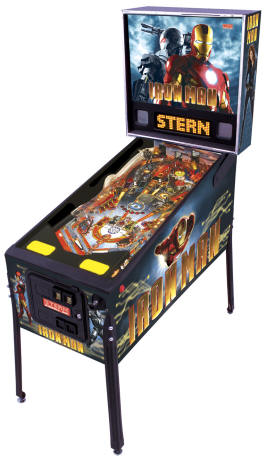
For around a decade, Stern was the only major pinball manufacturer left in the world. They survived by making machines based on bands, films and TV shows; Pirates of the Caribbean, AC/DC, Lord of the Rings, Sopranos, CSI, Terminator 3, Spider-man, Metallica, Avatar, Tron Legacy, The Simpsons, Batman, Indiana Jones and Iron Man all got a pinball machine, thanks to Stern.
The power of nostalgia
Thankfully, a deep-rooted love for pinball means there are plenty of people who will fight tooth and nail to see the industry commemorated and survive. As well as countless websites celebrating pinball, in 2009 the Las Vegas Pinball Collectors Club got together and opened the Pinball Hall of Fame. You can even do a Google Street View tour of the inside of the museum here. It is, quite frankly, incredible.
Inside the Pinball Hall of Fame, Las Vegas
Video pinball and emulation
For generations of pinball fans, they've only been able to enjoy the hobby because of a combination of original video pinball games and pinball emulators. Unlike arcade ROMs, which just need be ripped from the chips and emulated on MAME, Kayaks or whatever, digitising a pinball table accurately is an expensive and painstaking process. There is a community of people out there trying to do just that, with emulators such as PinMAME, Visual Pinball and Future Pinball, but like all emulation it is illegal - the scarcity of actual pinball machines does not get you out of that.
Thank God then for the mayor of Big Bear Lake, Jay Obernolte, whose video game company Farsight Studios, has been creating digital versions of classic tables from Gottlieb, Williams, Bally and Stern for the past decade. Initially they launched manufacturer-specific games with a dozen or so tables in them, but in 2012 they launched The Pinball Arcade. This all-encompassing, ever expanding pinball emulator features almost 50 classic tables and is available on pretty much every platform going.
Following in Farsight's footsteps, there is also Zaccaria Pinball by ASK Homework, which, as the name suggests, emulates Zaccaria tables (around two dozen of them). Unlike The Pinball Arcade, Zaccaria Pinball is only available on iOS and by all accounts it's a little buggy in comparison). But Zaccaria's machines are even harder to find in the real world than those from Bally, Williams, Gottlieb, Data East or any of the other big manufacturers, so let's hope it improves and becomes available on other platforms.
If you're willing to look outside of the classic tables, there is also Pinball FX 2 (known as Zen Pinball on some platforms), by Zen Studios. Also available on every platform going, Zen started out making original tables, such as Nightmare Mansion, Secrets of the Deep and Tesla. For the past couple of years they have gone the way of Stern and started making licenced tables, based on Marvel comics, Star Wars, the FIFA football association and other video games (the Plants Vs Zombies table is a riot).
One of many Star Wars-themed tables in Pinball FX 2/Zen Pinball
Sony also got in on the video pinball scene, with not one, but two games, both featuring licenced tables. For the original PSP there was Pinball Heroes. Released in 2010, it featured tables based on PlayStation 3 games such as Uncharted, Fat Princess, Pain and Everybody's Golf. More recently they released Pinball Rocks for iOS and Android. This rock and metal themed game features tables based bands such as AC/DC, Slayer, Alice in Chains and Bullet for my Valentine. Even movie studio MGM have produced a video pinball game - War Pinball, which features tables from based on movies such as Navy Seals, Missing in Action and (somewhat bizarrely) Platoon.
Pinball purists tend to scoff at video pinball, emulated or otherwise, criticising their physics and unrealistic features. Zen's games in particular include features that could not be done mechanically, such as figures that jump into the playfield to strike the ball and space ships flying around the table. While this annoys me a little, Zen's tables are still fun and challenging. More importantly, for the past decade these video pinball games are all most of us have had to slake our thirst for the silver ball.
The future of pin games
Despite the grim state of the industry a few years ago, things are starting to look up. In 2010, New Jersey-born business man Jack Guarnieri started up a new pinball manufacturer called Jersey Jack. Their début table is based on the MGM classic Wizard of Oz from 1939 and set pinball forums alight when they first announced the game. As this video shows, Jersey Jack have put their heart and soul into this table. It takes classic pinball elements and combines it with modern technology, like a 3D LCD back glass.
Then, in 2012, Andrew Heighway started up the UK's first major pinball manufacturer, Heighway Pinball. Seemingly coming out of nowhere, Heighway has some major industry names on-board, including artist Doug Watson (Attack from Mars, The Getaway: High Speed II, Terminator 2, Black Knight and Black Knight 2000)and designer Dennis Nordman (Elvira and the Party Monsters, Scared Stiff, Dr Dude, White Water (a person favourite). In an interview with the BBC, Andrew Heighway said, "There's been a huge boom in pinball smartphone and console games over the last
few years. ...thanks to these video games, there are plenty of kids that have been primed for
the real thing." That is a very interesting quote indeed.
Full Throttle's playfield with an LCD display in the middle
Jersey Jack and Heighway Pinball may have grabbed the headlines in recent years, but they aren't the only ones making new machines. Nordman (again) teamed up with pinball artist Greg Freres (Monster Bash, Strange Science, Star Trek: The Next Generation, Revenge from Mars and Medieval Madness) to create WhizBang Pinball. Together they made a limited number of bespoke pinball machines from other donor machines.
Nordman also teamed up with a new company called Multimorphic to help them create Lexy Lightspeed - Galaxy Girl, a brand new machine built on Multimorphic's P3 platform and due for release at the end of the year. Here's Lexy in action:
The beauty of the P3 system is that its designed to play more than one game on a single table, thanks to its large LCD play field. So as well as Lexy Lightspeed, the table will also play Cosmic Cart Racing when it's finished.I like the idea, but I can't help feeling it falls between two stools, being neither a fully mechanical pinball table, nor a "skies the limit" video pinball, like the sort of thing Zen Studios have been delivering. Rather than being the best of both worlds, it seems like a dilution of both technologies - but hey, at least they're trying.
I'm particularly excited to see what comes out of Heighway, not least because they are the UK's first major pinball manufacturer, but also because more than any other company out there, Heighway are trying to push the industry forward and take advantage of new technology, without compromising the spirit of traditional pinball. Not only that, but they are trying to build pinball machines smarter, replacing unreliable mechanical parts with sensors and other, most robust devices. They are also offering modular tables, making it easier for operators to swap and change faulty parts. The video below shows an early prototype for Heighway's upcoming Circe's Animal House. On the right you can see a blank "white board" version of the table playing, but on the left, you can see what at first appears to be graphics projected on to the surface of another blank table, but which is in fact a transparent LCD display. This allows Heighway to display effects, scores, characters, anything they like, whilst maintaining an entirely traditional playfield.
So with Stern providing the backbone of the industry, The Pinball Arcade reminding a new generation what's so great about pinball, and Jersey Jack and Heighway leading the charge for new developments, it appears pinball is in a better state now than it was 15 years ago. All we need now is for pubs, bowling alleys, seaside arcades and restaurants to start stocking these new machines and we're in business.
It's nearly Christmas, the decorations have been adorning shops since Halloween, the cheesy songs are playing on the radio and everywhere you look there are adverts for toys, gadgets, chocolates, booze, food, DVDs, books, games, you name it. With this in mind, I thought I'd end my run of top 10s genres with licensed games.
Video games have been part of the merchandise for TV shows, movies and toys for a long, long time. These days the term "licensed game" is generally regarded with derision, but once upon a time that wasn't always the case and there were plenty of classic arcade games that were also nothing more than merchandise for something else. Sticking to my rule of one game per franchise (sorry, Marvel), here is my top 10:
Star Wars
Let's start the show with a show stopper! Released in 1980 (the same year as the best Star Wars movie of all), this vector graphics X-Wing simulator set the tone for decades of Star Wars games to come. Despite the psychedelically-coloured graphics, the cabinet, the yoke controls and a samples from the movie meant this was as evocative as any games based on the classic franchise could hope to be. It's probably one of the most highly regarded arcade games of all time, let alone licensed ones.
RoboCop 2
Movie trailers are such delicious teases. I remember when the trailers for RoboCop 2 came out and thinking the antagonist robot, Kane, looked awesome. I can remember recording Film '90 just so I could replay the snippets of RoboCop battling Kane. My 15 year-old self was dizzy with excitement to see the film and sadly I had to wait for several years.
Data East had made an arcade game for the first RoboCop film, but where as that film was superior to its sequel, the sequel to the game was much better. From the gorgeous, sharp graphics to the novel little set pieces (such as forcing the truck back against a wall to crush it, as pictured above), this game let the player re-enact loads of key elements of RoboCop. At times, as a video game character he felt a little stiff, but the ability to shoot in a different direction to the one you were moving in (there was a button to shoot left and one to shoot right) did compensate for his rigidity some what.
WWF Super Stars
"I am a real American, doo doo doo dar dum dee doo dar." Sorry, where was I, oh yeah, WWF Super Stars hit the arcades at the same time as I first discovered "American wrestling". Although this game had a limited roster it did at least feature venerable favourites of the era Hulk Hogan, Randy "Macho Man" Savage, "Hacksaw" Jim Duggan, Ultimate Warrior and Big Boss Man (a favourite of mine at the time) among others. The game features lots of hallmark moves and the context-sensitive controls mean that with just two buttons and a joystick, each wrestler has a pretty good repertoire. The controls were a bit woolly to be honest, but this was as much a game of atmosphere as anything else and it captured the over-the-top action of 80s wrestling brilliantly. And given I only got to see wrestling when I went to a friend's house who had satellite TV, this game formed a major part of my childhood wrestling fanaticism.
Aliens
Man alive were there some great movies in the 80s and one of the best was James Cameron's Aliens. There were a number of arcade games made out of the franchise, but this (as far as I know) was the first. You take control of Ripley (with player 2 controlling who I can only assume was Hicks) as they try to rescue Newt from the alien infestation on LV426. There are one or two suspect aliens in this game, which I don't believe ever appeared in any of the movies, including weird bat creatures and mutants, but it's still a blast.
Dungeons & Dragons: Shadow Over Mystara
Capcom made a shed load of side scrolling beat 'em ups in the 90s, though few managed to better their classic Final Fight. However, this D&D brawler's use of simple RPG mechanics, including an inventory (something that was very rare in arcade games), makes it stand out from the pack. Of course it has all the staples of the genre: elves, dwarves, wizards, rangers, paladins, you name it. And all wrapped in a lovely bit of hack 'n' slash action. This game is now available of XBLA and PSN as part of a double-pack with its predecessor, Tower of Doom, both of which are great.
Indiana Jones and the Temple of Doom
Talking of classic 80s movies, the original Indiana Jones trilogy might be my favourite 80s trilogy; there isn't a dud in the pack. Many people say Temple of Doom was a let down, but the film's cheesy morbidity delighted me as a kid ("Ahh, chilled monkey brains!") and the mine cart chase was superb. As with some other movies in this list, I played the game long before seeing the film. The Temple of Doom game was in the arcade at the Old Hall, so I played it a LOT. There's not a lot to the game and if you aren't bothered about high scores you can always play it in easy mode and get a feel for the whole thing in just a few minutes, but in that short time you do get to play through many of the movies most memorable sequences, including the mine cart chase and the fight over the lava pit.
The Simpsons
There is a pattern to this list of games. WWF, Simpsons, D&D, Indiana Jones and Tron (see below) are all franchises I knew about because of the games as much (or something rather than) the source material. I didn't get to watch Simpson's until the late 90s, when my parents finally got cable TV, but because of this game I knew precisely who Homer, Marge, Bart, Lisa and Maggie were. The game itself was a madcap brawler, with each member of the family sporting their own special (and canonically accurate) moves. Marge's use of a vacuum cleaner could be seen as sexist, but it was funny to see one used (quite literally) in anger.
X-Men: Children of Atom
Here we are again, Capcom churning out loads of versions of basically the same game. Over the years they've made loads of Marvel-themed fighting games, primarily ones incorporating either Street Fighter characters or other Capcom characters. However, I prefer the purity of this super hero-only instalment, even if the roster of fighters is much reduced from the other games.
Teenage Mutant Ninja Turtles
What boy in the late-80s and early 90s didn't love the Teenage Mutant Ninja Turtles (or Teenage Mutant Hero Turtles, as they were known here in the UK)? I never read the comic, but I watched the cartoon and loved it. However, it was decidedly lacking in actual ninja action, with the turtles usually dispatching Shredder's foot soldiers with a bowl of spaghetti or a rubbish bin. So when the game let you wield each turtle's signature weapon (katana, bo staff, sai and nunchuks), what fan wouldn't lap it up?
Tron
This is an important game for me, because although I had played video games before it was this game, above all others, that made me fall in love with arcade gaming. It was so futuristic, with its neon paint and glowing pistol-grip joystick. In an arcade with a black light (which in my opinion is an essential piece of equipment for any arcade) this cabinet was stunning to behold.
It's 30 years since I first played this game and sadly its bespoke controls do not map to modern controllers very well at all. Whether it's on MAME or on XBLA, there is no good version to play, other than the original. As much as I love Street Fighter, if I had to have just one arcade machine, it would be Tron cabinet.
And that's it, all of the top 10 games by genre. I probably won't publish anything else this side of Christmas, so until next time, Merry Christ and a Happy New Year.
Run 'n' gun games may contain elements of shoot 'em ups and platformers, they can be modern day or futuristic, but whatever elements they're made of, they're all about blowing s**t up and taking names, just like the OTT action movies of the 80s and 90s. Speaking of which...
Ikari Warriors
One of the original top-down run 'n' gun games, Ikari Warriors is an all time classic. After crash landing your plane behind enemy lines, you have to fight your way up the scrolling jungle of enemy soldiers, taking weapons and also vehicles to aid your escape. The game is very clearly inspired by the Rambo films, with player 1's character looking almost exactly like Stallone (player 2 was the same, but blue). It's also one of those games that is difficult to translate to home platforms due to its rotating joystick controls (a problem we'll encounter again later on).
Metal Slug series
If you don't know what a typical run 'n' gun game looks like, you have obviously haven't played any of SNK's Metal Slug games. And if you haven't played any of these beautiful, violent and brilliantly ridiculous examples of arcade gaming, what the hell are you doing on a site like this? Metal Slug is one of the crowning jewels of SNK's legendary Neo Geo system and features some of the most detailed pixel art ever, but it's the high energy, high explosive, tongue-in-cheek gameplay that makes it a classic.
Gunforce: Battle Fire Engulfed Terror Island
If I was giving out awards for Most Awesome Subtitle, Gunforce: Battle Fire Engulfed Terror Island would probably win. This Irem run 'n' gun game from 1991 is very clearly inspired by Contra, but has a contemporary setting and two player co-op. Gunforce gives players the ability to lock the direction of fire by simply tapping the joystick and staying still, something many other similar games didn't do (such as Contra which always put the gun in a neutral position when you let go of the joystick). And although plenty of run 'n' gun games give you control of vehicles, there was something more free form about Gunforce's selection. They tended to be the same as the enemy vehicles and included screen-filling examples, such as the helicopter in the screenshot above.
Total Carnage
In the 90s, Midway were the kings of over-the-top, parent shocking video games, from the visceral digitised action of Mortal Kombat to the worship of the cathode ray tube and total disregard for human life that was Smash TV. Released in 1992, Total Carnage shares a lot in common with Smash TV. Many of the game play elements, weapons and even characters came from Smash TV. As the name suggests, this is probably the craziest, crassest game in this list - a delight for teenage boys who grew up watching Willis, Van Damme, Lundgren, Sly and Arnie in action. The game also features an interesting password system, that will let you warp to sections of the if you know the four letter code.
Cyber-Lip
Here's another one from the SNK Neo Geo. Released a few years before Metal Slug, Cyber-Lip takes the game play of Contra and the plot from Terminator. You and a friend take control of two human soldiers, sent to take out the robotic army that's terrorising Earth after a military super computer goes haywire. Some notable features of Cyber-Lip are the ability to shimmy along handrails and the fact when you die you come back on a flying jet ski thing, which, for a few seconds, not only gives you the ability to clear the screen, but also allows you to position yourself where ever you like.
And no, I don't know what a Cyber-Lip is.
Mercs
Capcom's 1985 Commando was one of the earliest examples of vertically scrolling run 'n' gun games, pre-dating Ikari Warriors by a year. However, sticking to my rule of only including one game from any series, I must confess to preferring the faster, more hectic sequel from 1990. This game not only plays great, it looks great too, with clean, yet detailed pixel art that for some reason reminds me of Bitmap Brothers games. Unlike some of the other top-down games in this list, Mercs doesn't require any specialised controls, which means it translated well to home platforms too.
Midnight Resistance
I have found memories of various Data East games, but none more so than Midnight Resistance from 1989. Like many of the games in this list, the characters looked like Rambo, but then he was the biggest action hero around at the time. Fallen enemies would sometimes drop keys, of which players could collect up to six. At the end of each level you break into a weapons store and each weapon or ammunition pack would require a certain number of keys to unlock. This was effectively just a coin and shop system, but it was more in-keeping with the story than having a random shop in the middle of the war-torn environment. This is another game that requires a rotating stick and so it didn't translate well to home platforms.
Finest Hour
Despite taking its name from a Winston Churchill speech, Namco's Finest Hour from 1989 is actually set in the future and puts the player in control of an armoured robot, seeking out the enemy in a jungle-like terrain and blasting them to smithereens. Finest Hour has a few unusual features. Firstly, it has an auto-lock on for the main gun and second, although it's not a one-hit-death game, you don't have health either. Instead you have a heat gauge, which goes up when you are hit. If the meter reaches critical, you blow up. However, stay out of danger for long enough and you'll cool down again. So when people talk about the auto-recharging health and shields of modern games like Halo, Gears of War and Call of Duty, you have to wonder if it started here. Officially, the game was only available in Japan, but I do remember it making it over to a few UK arcades.
Rolling Thunder series
A former Classic of the Month, Namco's Rolling Thunder oozes spy style. The original had super smooth and detailed animation to go along with its great gameplay and atmosphere; the sequels added more locations, improved graphics and two player. The sequels are also some of the few run and gun games that put player 1 in control of a female protagonist (although others, such as later Metal Slug games, had optional female characters).
Alien Syndrome
Firstly, I love, love, love Sega's 1987 classic Alien Syndrome! I mean, I have soft spots for all the games in this list, but I have particularly found memories of Alien Syndrome - not so much the arcade original as the Sega Master System conversion. It wasn't as fast, but I always thought the graphics were cleaner. Nonetheless, this game manages to evoke the sense of foreboding and dread that permeates the Sigourney Weaver movies and with the kind of squelchy, undulating monstrosities found in John Carpenter's The Thing. Unlike the other games in this list, the maze-like structure of the levels of this game force players to explore and the time bomb ticking down in the background only added to the sense of dread.
Contra (AKA Gryzor)
Characters that looked like Arnie and Sly? Loads of big, crazy guns? Soldiers, robots and aliens to blast? What was not to like about Contra - or Gryzor as I knew it in the 80s. I was truly terrible at this game, but it wasn't until I was much older that I discovered it is generally considered one of the hardest games of that period. I own the Xbox Live Arcade version and even when I lower the difficulty and use all my continues, I still can't get past level 3. This game also made it to my original Top 10 list of seminal arcade games from my youth and for good reason. As good as similar games are in this list, Contra is still my favourite. So you can imagine how excited I was a few years ago when the games company I worked for at the time were pitching for the contract to do a modern remake of this classic franchise. Sadly, the bid fell through and it wasn't to be.
Join me again next month when I'll be counting down my top 10 light gun games.
More of a sub-genre of beat 'em ups than a genre in its own right, hack 'n' slash games differ from other beat 'em ups and fighting games in that they tends to have medieval and fantasy settings rather than being about dingy backstreet dust ups. So, it's time to put on your elf ears, dwarf beards and maybe dig out your shurikens too, as we look at MTW's top 10 hack 'n' slash games:
Golden Axe series
Of course Sega's seminal Golden Axe was going to be in the list, so let's get it out of the way to begin with. Although there had been co-operative games before, with Golden Axe it felt like the way the game was meant to be played. I've always put this down to how well the three characters' skills complemented each other. My favourite, the dwarf Gilius Thunderhead, has melee range, but weak magic; the barbarian, Ax Battler, has balanced melee and magic; the armoured bikini-wearing Tyris Flare had the best magic, but the weakest melee skills. By playing Golden Axe with a friend you didn't just double your fire power, you increased your tactics too.
Rastan Saga
Taito's Rastan Saga is was one the granddaddies of the hack 'n' slash genre. The titular hero is your typical, Conan-esque barbarian, who has to carve his way through hordes of lizardmen to rescue, what else, a princess. Rastan's gameplay has almost as much in common with platformers as it does hack 'n' slash beat 'em ups, with Rastan having to jump and plunge his way around the landscape in order to reach his destination at the end of each level.
Ninja Spirit
After Tolkien-esque fantasy, the next most common topic for the hack 'n' slash genre is ninjas. Few arcade games give players as strong a sense of being a stealthy night blade as Irem's Ninja Spirit. From the outset players are able to choose which of four weapons they want to use (a katana, shurikens, bombs or a kusarigama), but things get really interesting when our hero, Gekkou, collects the magic gems that summon ninja spirits, which follow him and repeat his actions (with about a half second delay). But don't let all this arsenal fool you, Ninja Spirit is rock hard!
Rygar
Playing Rygar again for this article, I'd forgotten just how bloody fast it is. The game throws everything at the player and there's a surprising variety of creatures and minions to deal with too, like pteranodons, headless hulks, burrowing centipede monsters and rhino dog things. Thankfully, Rygar's flying, spiked shield has plenty of reach, so with a bit of good timing it's possible to stop all of these monstrosities from ever getting close.
Magic Sword: Heroic Fantasy
In the early 90s, Capcom released a load of great fantasy hack 'n' slash games, starting with this, Magic Sword. The game has character classes that will be instantly familiar to anyone who's ever played a tabletop role-playing game or indeed a MMORPG. There's a knight, a priest, a thief, a wizard, a ninja, an amazon, a lizardman and the bizarrely named bigman. Whatever. Each one has their pros and cons, such as the priest who is generally the weakest, but is particularly powerful against the undead. What's different here is that the players do not take control of these different classes. Instead you control a generic warrior and have to rescue the other classes, at which point they will fight alongside you, mimicking your moves (a bit like the spirits in Ninja Spirit). The game also got ported to Xbox Live Arcade and PlayStation Network a few years, in the Final Fight: Double Impact compilation, so there's no excuse to miss out on this one.
Knights of the Round
Released in 1991, Capcom's Knights of the Round is obviously based on the legend of King Arthur. Players get to choose from Arthur, Lancelot or Perceval and in classic style, each one has their own skills and abilities. In a nod to role-playing games, each character can be levelled up during the course of the game (a theme that we'll see repeated a lot in this top 10). Ostensibly, KotR is pretty basic, but it's the game's blocking system that really makes it shine. Hit attack and back at the right time and you gain a few seconds of invincibility. It's a simple and effective system, that was rarely seen at the time.
Shadow Dancer
Despite the ninja hero, the Eastern magic and the white wolf, we switch to modern day (or at least modern at the time) for our next game. Sega's Shinobi series is legendary, but the series really upped its game with this instalment. The addition of Shinobi's canine companion seemed remarkable at the time, especially as you were given limited control of the beast in order to set him on certain, otherwise hard to reach, enemies (such as the sniper in the screenshot above).
Gauntlet Legends/Dark Legacy
Released 13 years after the original, Gauntlet Legends and the sequel from the following year, Dark Legacy, features 3D polygon graphics and an isometric view that's more akin to modern action RPGs such as Torchlight, Path of Exile and Diable III as anything else. I originally played Legends on my Dreamcast, but it was a pretty close conversion by all accounts. As with other fantasy-themed games in this list, Legend and Dark Legacy feature a rudimentary levelling sysem, but the health and gold works much as it did in the original games. Unlike the original, the game has much more focus on melee combat, as opposed to throwing an endless supply of axes at your foe (how did the barbarian ever carry so many?), which is why it gets to join this list.
Strider
When I first saw Strider, I was blown away by how agile Hiryu was and dazzled by the flashing arc of his katana as he cut a swathe through scores of Soviate soldiers and bizarre robots, such as the ape pictured above. The game's future Russian setting and multi-lingual voices also made this one stand out from the crowd. For me, this is the game that first made me pay attention to Capcom and as this list has shown, they were a company to watch in the late 80s and early 90s.
Dungeons & Dragons: Tower of Doom/Shadow Over Mystara
With the official Dungeons & Dragons licence attached to it, Capcom's pair of hack 'n' slash games Tower of Doom and Shadow Over Mystara are perhaps the closer to a proper role-playing game than any other arcade game. Both games are great, which is why they are sharing a spot in this list, but for me Shadow Over Mystara probably has the edge. With all the typical classes and creatures, a rudimentary inventory system for both clothing and weapons, and dripping with fantasy lore, this game has pretty much everything you'd want from an arcade D&D game. Both games are available on Steam, Xbox Live Arcade and PlayStation Network as a double pack called Dungeons & Dragons: Chronicles of Mystara, so as with Magic Sword, there's no need to miss out.
There we have it, all the swords, knights, ninjas, magic, princesses and dragons an arcade throwback could want. As with any of my top 10s, there are bound to be games other people would have included in their list (I have no doubt there are a few people screaming, "What about Ninja Gaiden?!" or "Err.. you forgot King of Dragons!" but these are the ones I'd be putting 20p into, given the choice.