There are things from your childhood that will stay with you your whole life, memories that sit deep inside your subconscious and are never forgotten, even if you cannot instantly recall them. Some of these memories may be significant — the death of a grand parent or some achievement at school — but some will be trifling. For me, one of the latter memories is the dark Gothic art work for Bally's pinball table, Centaur. I did not know the name of the table, only the backboard art, with the H.R. Gigar-esque design of the part demon, part motor cycle, wielding a battle axe and the leather-clad rock chick riding him. It scared me and made me think the people playing the table must be dark, malevolent types, but it fascinated me all the same. It was only when Farsight Studio's converted the table for their Pinball Arcade platform that my memories all clicked into place. As soon as I saw it I had to play it and I found that beyond the scary art is a brilliant pin. Since then I've played the table a lot, but I still find Paul Faris's art work a little creepy, so I had to make it my Halloween classic for 2014.
The stark, dingy art work of the backboard and sides carries over on to the playfield, which is one of the gloomiest ever made; everything is black, white and red. If you play on a table with dim or faulty bulbs, it can be quite difficult to see anything at all. Like many tables from the early 80s, Centaur has primitive synthesized sound that, although basic, only adds to its eerie atmosphere. As you play the table instructs you to "Destroy Centaur" and says the names of the table's various features as you enable them.
Key to success in Centaur are the table's O.R.B.S. drop targets, which can initiate multi-ball mode in a number of ways. Drop all four targets and you'll lock a ball for multi-ball. Drop the targets in order and you'll both lock a ball and trigger a multi-ball at the same time. To initiate the multi-ball you have to hit the captive ball in the chamber on the top left and knock down another series of drop targets, until eventually you hit the release target to launch the locked balls. However, it takes considerable skill to do this, which is why the table is such a beloved classic. Thankfully, that's not the only way to get multi-ball on Centaur and in fact it's possible to "lock" balls without ever having a ball go out of play, thanks to a clever trap-door launch mechanism under the shooter lane.
I used to think nudging was kinda cheating, but here it is encouraged in the game's design. There are small, rubber notches on the outlanes, which, if you rock the table just so, will bounce the ball back into play, preventing it from draining.
This table is too early for DMD, so it has 7-bit displays for the scores. This means that unlike later tables the amount of direction the player gets from the backboard is limited. Thankfully, as well as its famous synthesized voice commands, the game also makes clever use of colour-coding. with different coloured bulbs showing the player which targets trigger which features. For example, a green light in the top right hand corner indicates that the target behind can be used to reset the green drop targets below.
Playing it today, Centaur may look basic, with no ramps, multiple tiers or even spinners. However, its multifaceted multiball mechanism makes it every bit as rewarding as many more intricate-looking tables. The video below shows a beautifully restored Centaur table in action, which looks brighter than a normal table thanks to the LEDs that have been used to replace the original bulbs.
And this video, by the brilliant Todd Tuckey of TNT Amusements, explains the rules brilliantly.
I still vow to own a pinball table one day and while it's likely I'll opt for a newer, more reliable Stern, Jersey Jack or Heighway table, when it comes to classic pins, Centaur is very high on my want list.
And as a final note, if you're looking for more Halloween games, Pinball Arcade has recently added Phantom of the Opera and Bram Stoker's Dracula, to go along with Centaur and its other spooky tables, such as Haunted House, Gorgar, Class of 1812, Monster Bash and both Elvira tables.
Here on Arcade Throwback, when I write a classic of the month feature, I talk about games I've played. Usually I've will have played the original arcade machine, but sometimes I've only ever played a port, conversion or occasionally, an emulated version (if it's something rare, like Aztarac, which I covered in February. This month's classic is a game I've never seen or played in any form, but boy do I want to.
As you'll know, Arcade Throwback loves video games and pinball in equal measure, and so why wouldn't I crave a machine that combines these two loves and wraps it in one of the biggest arcade franchises of all time -- Pac-Man!
After the initial success of Pac-Man in the arcades, development of the sequels was split between the original developers (Namco) and the US/EU distributors (Bally/Midway). So while Namco gave us Super Pac-Man, Bally/Midway produced games like Ms Pac-Man and it is that spin-off that spawned Baby Pac-Man, a character who first appeared in the intermissions of Ms Pac-Man, courtesy of a stoke (what else?).
The machine itself is noteworthy as a brilliant piece of design. Its form factor is hardly any different to a standard upright arcade machine. The difference is that where the monitor would traditionally sit (in the bottom of the cabinet, facing up), is a compact pinball table. The display of the video game portion is then a 10" monitor, housed horizontally. The playfield of pinball table goes underneath the monitor, making the best possible use of the space.
In terms of gameplay, this is one of the most different games in the entire series. The video game portion is your usual ghosts and maze combo, however there are no power pills. In order to get one of those, you have to guide Baby Pac down one of the tunnels at the bottom of the maze, where upon the video game halts and a silver ball is released on to the table.
The playfield for the table is relatively simple and also quite symmetrical. Hitting the 4 targets at the top of the playfield lights up a letter of the word PACMAN in the corresponding column. Complete a column and you earn a power pellet. You can also earn a power pellet by hitting the captive ball that loops between the 1st and 4th columns. In the centre is a blue target. Hit it 6 times and you get an extra life. In the top corners are are loops, each of which leads to a rollover and an inlane (there are no outlanes). The left the loop has the letters FRUITS, which will light up one at a time with each successive rollover. Every time you complete all six letters a higher scoring fruit appears on the maze. On the right is a same thing, but with the word TUNNEL. Spell this out and you effectively power up the tunnels, so you can evade the ghosts more quickly.
In a unique twist, losing the ball is integral to the game, as this is how you get back into the video game portion. Only here can you lose a life and lose a life you will, because this game is even more relentless than Ms Pac-Man. If you've been successful in the pinball portion of the game then you'll have some better fruit and (crucially) some power pellets, but now the tunnels to the pinball table are closed. They will only re-open if you clear the level or die (I'll leave you to guess which is the more likely).
In theory you can play whichever part of the game you choose, but in reality you have to think when it will benefit you the most to drop down into the pinball game and whether or not you play the pin game for as long as possible or just long enough to get what you want to play the video game. The balance of the game is such that the chances are you will have to flick between both to be truly successful.
When I think of arcade machines (not just the games) I would love to play these days, this is right up there with a hydraulic Space Harrier, a G-Loc 360 and a Star Rider, because it offers something so few games have ever offered. Despite how good this game is, it wasn't very popular and as such there are very few examples of other hybrid machines. It's an idea that Williams tried to resurrect with their Pinball 2000 system, by adding holographic video game sequences to Revenge from Mars and Star Wars: Episode 1 pinball tables, but by all accounts neither game were as good as Baby Pac-Man.
Here's some footage from John's Arcade which shows the game off really well, although warning, there is some swearing between 6:05 and 6:20.
At the beginning of Steven L. Kent's 'Ultimate History of Video Games' there is this quote by former CNN Computer Connection producer, Steven Baxter, which says:
"You can't say that video games grew out of pinball, but you can assume that video games wouldn't have happened without it. It's like bicycles and automobiles. One industry leads to the other and they exist side by side. But you had to have bicycles to one day have motor cars."
So when people point at Pong or even the oscilloscope game Tennis for Two, way back in 1958, as the origins of video games, they are missing out on this simple truth. With that in mind here is Arcade Throwback's brief history of pinball, the true origin of arcade gaming and the huge home and mobile gaming industry we know today.
Bagatelle and the beginning of pinball
Being essentially mechanical in nature, pin games have been around for centuries, all the way back to Bagatelle tables in the 15th century, like the one below.
An example of a Bagatelle table.
Even without flippers, flashing lights, ramps or digitised score[board]s, it's easy to see how this could be the origin of pinball, although it's actually a form of billiards. Some versions of Bagatelle also included wooden pins, which had to be avoided in order to get the balls into the cups. A few centuries later, a variant called billiard Japonais (Japanese billiards) replaced the cues with a plunger and the free-standing wooden pins with fixed, metal pins (basically nails). Billiard Japonais went on to inspire a few other games, including pachinko and something that got us a whole lot closer to the pinball we know today, but for that we need to fast forward to the 1930s.
Baffle Ball and Ballyhoo
In 1931 David Gottlieb invented a variation of billiard Japonais which he called Baffle Ball. In this new game players had to rock the table to get the balls into the desired hole — a technique that would later become known as nudging. Compare the photo of Baffle Ball (below) to the photo of the Bagatelle table above and the resemblance is undeniable.
Gottlieb's first pin game.
The success of Gottlieb's game meant it wasn't long before others started to create their own pin games. Among them was Ray Moloney, owner of Lion Manufacturing and creator of Ballyhoo. Moloney's game was so successful, he decided to change his company name to Bally and a future legend of pinball was born.
By all accounts, Gottlieb had a knack for balancing skill and challenge to make fun games, but around the same time another big name for pinball emerged. His name was Harry Williams and he was a Standford-educated engineer, which meant he knew how to create complex mechanisms for his games. In 1933 he created Contact, the world's first electric pinball game. Previously, once a ball landed in a scoring pocket, it had to be retrieved by hand (either by picking it out of the pocket or from a collection tray at the bottom). Contact's scoring pockets had electrically-powered contacts (hence the name) that knocked the ball back into play, allowing the game to continue uninterrupted. Unfortunately, it is around this time that problems started to occur for pinball and pin games, all of which linked back to early gambling machines called pay-outs, which looked a little like pinball machines. It seemed some people in authority couldn't (or wouldn't) see the difference.
Pinball outlawed
A pinball machine being demolished after a raid
By the 1940s, pinball was outlawed in many parts of America, as it was thought to be a form of gambling with links to organised crime. It was also thought to be a bad influence on America's impressionable youth, who would waste their time and money on the games. In 1942, New York Mayor, Fiorello La Guardia, authorised raids on pinball establishments and issued arrest warrants for their owners. And what happens when the authorities try to ban something? It goes underground, develops an almost mythical reputation and becomes more popular than ever. The manufacturing, innovation and popularity of pinball continued unabated, with Chicago becoming the capital of pinball production, despite it also being illegal there. It was in the windy city that Gottlieb, Bally and Williams were all based. Gottlieb in particular battled to legitimise his games. He knew the key would be to prove pinball was more than a game of chance, which meant his games needed to demonstrate the need for skill.
Putting the flip into pinball
In 1947, Harry Mabs, one of Gottlieb's engineers, added spring-powered "flipper bumpers" to a game called Humpty Dumpty. The flipper bumpers were used to knock the ball back into play, in exactly the same way as modern pinball, which added weight to Gottlieb's argument that pinball needed skill to play. As the video below shows, Mabs' flipper bumpers were not located at the bottom and there were more than two of them - in fact, there were six:
Flippers revolutionised pinball, to the point that in France, pinball tables are known as le flipper. Gottlieb's competitors got in on the act and for the next few years all pin games had six flippers in a similar arrangement to Humpty Dumpty. Eventually having two flippers at the bottom of the table became the norm, but it was actually for reasons of thrift, rather than design choice. The man to thank for that was Steve Kordek, a designer at a company called Genco. He was under instructions to save money in his designs, so he reduced the number of flippers to two and in order to make them as useful as possible, he put them at the very bottom of the table. The result was a table called Triple Action. It's still not quite the pinball we know today, as the flippers still pivoted from the middle of the table, rather than the outside edges (a la Humpty Dumpty), but it was still a major step forwards.
Two flippers at the bottom. The start of something big.
The introduction of flippers proved pinball needed skill to play and by the mid-70s most US cities lifted the ban. This is what Gizomodo has to say about the day the ban on pinball was lifted in New York:
"In May of 1976 in New York City, Roger Sharpe watched nervously as city council members piled into a Manhattan courtroom. Reporters and camera operators had already begun setting up, eagerly anticipating the proceedings ahead. Roger, a young magazine writer for GQ and the New York Times among others, did not expect this kind of attention. He knew lots of people, from bowling-alley-hanging teens to the Music & Amusement Association, were depending on him, but didn’t realize the whole country would be watching. Roger had been selected for this particular task not only for his knowledge and expertise, but for his legendary hand-eye coordination. He was there to prove that this was a game of skill, not chance. He was there to overturn the ban. He was there to save the game of pinball."
Despite this, bans on under 18s playing pinball remained in various parts of the US up until the 2000s and pinball was still illegal in the town of Beacon, NY, up until 2010 (and may still be). I cannot find anything to suggest pinball was banned in the UK, but our laws did influence the industry. In 1991, UK laws on chance games saw the introduction of the ball saver feature. This is why modern pinball tables will often give you a free ball if, straight after being launched, it drops out the bottom without the player hitting it.
Dark heart of the arcade
For decades, the pinball machine was a symbol of delinquency and rebellion, like rock 'n' roll and motorcycles. Even up until the 1980s, antagonists in movies were sometimes seen playing pinball, as if to imply that was part of their dangerous personalities. YouTuber Bumper McBaulogh (I believe that's his actual real name) has made a series of videos called Pinball in the Movies, which shows clips of films that feature pinball, with no voice over or any other narrative about the nature of the machines' representation. In each case, the machines are in some way linked to immoral, unscrupulous or outright illegal activities. You can check out Bumper's channel here. Perhaps the most graphic example of a pinball table being associated with dangerous, even evil people, was in the 1988 Jonathan Kaplan film, The Accused. If you haven't heard of the film, it features a grotesque sequence in which a drunk Jodie Foster is held down and gang raped on a re-branded Bally Space Invaders table (called Slamdunk in the film, which feels like some kind of tasteless pun, given the context).
From my memories as a child, pinball tables seemed to attract a more sinister crowd than the likes of Frogger or even Mortal Kombat. In the arcades I visited, pinball machines were separate from the video games and were often located with the one-armed bandits and fruit machines (that link to gambling still rearing its ugly head again). Many of the tables I encountered in smoky city centre arcades were based on horror movies or some other Gothic theme. Tables such as Tales from the Crypt, Centaur,Freddy: A Nightmare on Elm Street, Haunted House, Gorgar and Spooky all instantly spring to mind.
But that's enough about the negative side of pinball.
Innovations and the golden age of pinball
Harry Williams' electric contacts began the steady technological progress of pinball. From the 40s up to the 70s electromechanical (EM for short) machines ruled pinball. As the name suggests, these used electrically-powered mechanisms, such as relays, to control things like sink hole returns, slingshots, bumpers and even scoreboards. These machines had very limited sound, usually nothing more than a bell and the clatter of the relays, which even today are synonymous with pinball.
An EM scoreboard from a Williams Go Go Pinball machine
In the 70s, consumer electronics blew up in a big way, with the first wave of electronic record players, video cameras and home computers emerging from America and Japan. It was in 1976 that Micro Games released the first solid state pinball machine, Spirit of '76. Gone were the relays, now the gameplay and scoring was controlled by electronic circuits. Along with the circuit boards came LED scoreboards, sound effects, synthesized music and eventually voices, which could issue instructions (or sometimes taunts) to the player. It was the beginning of the golden age of pinball.
Spirit of '76, apparently the first electronic pinball machine.
From 1977 onwards solid state machines ruled the pinball scene and by the end of the 80s, pinball was more popular than ever, but there was another, even bigger change on the horizon.
In 1991, Data East introduced a new kind of score board into a machine called Checkpoint. This new technology used an array of orange LEDs to create a dot matrix display (or DMD for short). It was the biggest innovation in pinball since Harry Mabs added flippers to Humpty Dumpty. Not only did DMDs allow pinball manufacturers to display graphics in their games, they could also give the player detailed instructions and even provide stories for the player to follow. This elevated the gameplay above simply hitting targets, bumpers and ramps in order to get high scores, now players could aim to trigger the next chapter in an interactive blend of story, skill game and puzzle.
Decline of the industry
Sadly, as arcades diminished, so too did the demand for pinball tables. Despite new innovations and attempts to attract new players, pinball machines were dragged under with the fall in popularity of video arcade games. Below is Bally's promotional video the classic Cirqus Voltaire from 1997. This video includesa company briefing with a sales chart clearly showing the decline in pinball's popularity over the past few years.
This decline was not just a bump in the road, but the edge of a cliff for pinball. By the end of the millennium, most of the great manufacturershad gone out of business.
Here's a list of casualties:
Italian manufacturer, Zaccaria, stopped making pin games in 1988.
Data East was bought by Sega in 1994 and renamed "Sega Pinball".
Midway sold Bally to the Hilton Hotel group in 1995, but made no more pin games.
1996 saw the end of Gottlieb, Alvin G & Co. and Capcom's pinball division.
Williams went under in 1999, despite their attempts to revitalise interest in pin games with their hybrid "Pinball 2000" machines.
In 1999 Sega sold their pinball division (which was formerly Data East's) to the then President of Sega Pinball, Gary Stern who called his new company "Stern Pinball".
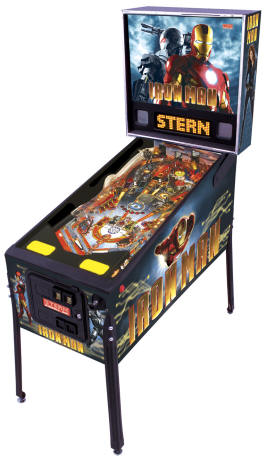
For around a decade, Stern was the only major pinball manufacturer left in the world. They survived by making machines based on bands, films and TV shows; Pirates of the Caribbean, AC/DC, Lord of the Rings, Sopranos, CSI, Terminator 3, Spider-man, Metallica, Avatar, Tron Legacy, The Simpsons, Batman, Indiana Jones and Iron Man all got a pinball machine, thanks to Stern.
The power of nostalgia
Thankfully, a deep-rooted love for pinball means there are plenty of people who will fight tooth and nail to see the industry commemorated and survive. As well as countless websites celebrating pinball, in 2009 the Las Vegas Pinball Collectors Club got together and opened the Pinball Hall of Fame. You can even do a Google Street View tour of the inside of the museum here. It is, quite frankly, incredible.
Inside the Pinball Hall of Fame, Las Vegas
Video pinball and emulation
For generations of pinball fans, they've only been able to enjoy the hobby because of a combination of original video pinball games and pinball emulators. Unlike arcade ROMs, which just need be ripped from the chips and emulated on MAME, Kayaks or whatever, digitising a pinball table accurately is an expensive and painstaking process. There is a community of people out there trying to do just that, with emulators such as PinMAME, Visual Pinball and Future Pinball, but like all emulation it is illegal - the scarcity of actual pinball machines does not get you out of that.
Thank God then for the mayor of Big Bear Lake, Jay Obernolte, whose video game company Farsight Studios, has been creating digital versions of classic tables from Gottlieb, Williams, Bally and Stern for the past decade. Initially they launched manufacturer-specific games with a dozen or so tables in them, but in 2012 they launched The Pinball Arcade. This all-encompassing, ever expanding pinball emulator features almost 50 classic tables and is available on pretty much every platform going.
Following in Farsight's footsteps, there is also Zaccaria Pinball by ASK Homework, which, as the name suggests, emulates Zaccaria tables (around two dozen of them). Unlike The Pinball Arcade, Zaccaria Pinball is only available on iOS and by all accounts it's a little buggy in comparison). But Zaccaria's machines are even harder to find in the real world than those from Bally, Williams, Gottlieb, Data East or any of the other big manufacturers, so let's hope it improves and becomes available on other platforms.
If you're willing to look outside of the classic tables, there is also Pinball FX 2 (known as Zen Pinball on some platforms), by Zen Studios. Also available on every platform going, Zen started out making original tables, such as Nightmare Mansion, Secrets of the Deep and Tesla. For the past couple of years they have gone the way of Stern and started making licenced tables, based on Marvel comics, Star Wars, the FIFA football association and other video games (the Plants Vs Zombies table is a riot).
One of many Star Wars-themed tables in Pinball FX 2/Zen Pinball
Sony also got in on the video pinball scene, with not one, but two games, both featuring licenced tables. For the original PSP there was Pinball Heroes. Released in 2010, it featured tables based on PlayStation 3 games such as Uncharted, Fat Princess, Pain and Everybody's Golf. More recently they released Pinball Rocks for iOS and Android. This rock and metal themed game features tables based bands such as AC/DC, Slayer, Alice in Chains and Bullet for my Valentine. Even movie studio MGM have produced a video pinball game - War Pinball, which features tables from based on movies such as Navy Seals, Missing in Action and (somewhat bizarrely) Platoon.
Pinball purists tend to scoff at video pinball, emulated or otherwise, criticising their physics and unrealistic features. Zen's games in particular include features that could not be done mechanically, such as figures that jump into the playfield to strike the ball and space ships flying around the table. While this annoys me a little, Zen's tables are still fun and challenging. More importantly, for the past decade these video pinball games are all most of us have had to slake our thirst for the silver ball.
The future of pin games
Despite the grim state of the industry a few years ago, things are starting to look up. In 2010, New Jersey-born business man Jack Guarnieri started up a new pinball manufacturer called Jersey Jack. Their début table is based on the MGM classic Wizard of Oz from 1939 and set pinball forums alight when they first announced the game. As this video shows, Jersey Jack have put their heart and soul into this table. It takes classic pinball elements and combines it with modern technology, like a 3D LCD back glass.
Then, in 2012, Andrew Heighway started up the UK's first major pinball manufacturer, Heighway Pinball. Seemingly coming out of nowhere, Heighway has some major industry names on-board, including artist Doug Watson (Attack from Mars, The Getaway: High Speed II, Terminator 2, Black Knight and Black Knight 2000)and designer Dennis Nordman (Elvira and the Party Monsters, Scared Stiff, Dr Dude, White Water (a person favourite). In an interview with the BBC, Andrew Heighway said, "There's been a huge boom in pinball smartphone and console games over the last
few years. ...thanks to these video games, there are plenty of kids that have been primed for
the real thing." That is a very interesting quote indeed.
Full Throttle's playfield with an LCD display in the middle
Jersey Jack and Heighway Pinball may have grabbed the headlines in recent years, but they aren't the only ones making new machines. Nordman (again) teamed up with pinball artist Greg Freres (Monster Bash, Strange Science, Star Trek: The Next Generation, Revenge from Mars and Medieval Madness) to create WhizBang Pinball. Together they made a limited number of bespoke pinball machines from other donor machines.
Nordman also teamed up with a new company called Multimorphic to help them create Lexy Lightspeed - Galaxy Girl, a brand new machine built on Multimorphic's P3 platform and due for release at the end of the year. Here's Lexy in action:
The beauty of the P3 system is that its designed to play more than one game on a single table, thanks to its large LCD play field. So as well as Lexy Lightspeed, the table will also play Cosmic Cart Racing when it's finished.I like the idea, but I can't help feeling it falls between two stools, being neither a fully mechanical pinball table, nor a "skies the limit" video pinball, like the sort of thing Zen Studios have been delivering. Rather than being the best of both worlds, it seems like a dilution of both technologies - but hey, at least they're trying.
I'm particularly excited to see what comes out of Heighway, not least because they are the UK's first major pinball manufacturer, but also because more than any other company out there, Heighway are trying to push the industry forward and take advantage of new technology, without compromising the spirit of traditional pinball. Not only that, but they are trying to build pinball machines smarter, replacing unreliable mechanical parts with sensors and other, most robust devices. They are also offering modular tables, making it easier for operators to swap and change faulty parts. The video below shows an early prototype for Heighway's upcoming Circe's Animal House. On the right you can see a blank "white board" version of the table playing, but on the left, you can see what at first appears to be graphics projected on to the surface of another blank table, but which is in fact a transparent LCD display. This allows Heighway to display effects, scores, characters, anything they like, whilst maintaining an entirely traditional playfield.
So with Stern providing the backbone of the industry, The Pinball Arcade reminding a new generation what's so great about pinball, and Jersey Jack and Heighway leading the charge for new developments, it appears pinball is in a better state now than it was 15 years ago. All we need now is for pubs, bowling alleys, seaside arcades and restaurants to start stocking these new machines and we're in business.
It's nearly Christmas, the decorations have been adorning shops since Halloween, the cheesy songs are playing on the radio and everywhere you look there are adverts for toys, gadgets, chocolates, booze, food, DVDs, books, games, you name it. With this in mind, I thought I'd end my run of top 10s genres with licensed games.
Video games have been part of the merchandise for TV shows, movies and toys for a long, long time. These days the term "licensed game" is generally regarded with derision, but once upon a time that wasn't always the case and there were plenty of classic arcade games that were also nothing more than merchandise for something else. Sticking to my rule of one game per franchise (sorry, Marvel), here is my top 10:
Star Wars
Let's start the show with a show stopper! Released in 1980 (the same year as the best Star Wars movie of all), this vector graphics X-Wing simulator set the tone for decades of Star Wars games to come. Despite the psychedelically-coloured graphics, the cabinet, the yoke controls and a samples from the movie meant this was as evocative as any games based on the classic franchise could hope to be. It's probably one of the most highly regarded arcade games of all time, let alone licensed ones.
RoboCop 2
Movie trailers are such delicious teases. I remember when the trailers for RoboCop 2 came out and thinking the antagonist robot, Kane, looked awesome. I can remember recording Film '90 just so I could replay the snippets of RoboCop battling Kane. My 15 year-old self was dizzy with excitement to see the film and sadly I had to wait for several years.
Data East had made an arcade game for the first RoboCop film, but where as that film was superior to its sequel, the sequel to the game was much better. From the gorgeous, sharp graphics to the novel little set pieces (such as forcing the truck back against a wall to crush it, as pictured above), this game let the player re-enact loads of key elements of RoboCop. At times, as a video game character he felt a little stiff, but the ability to shoot in a different direction to the one you were moving in (there was a button to shoot left and one to shoot right) did compensate for his rigidity some what.
WWF Super Stars
"I am a real American, doo doo doo dar dum dee doo dar." Sorry, where was I, oh yeah, WWF Super Stars hit the arcades at the same time as I first discovered "American wrestling". Although this game had a limited roster it did at least feature venerable favourites of the era Hulk Hogan, Randy "Macho Man" Savage, "Hacksaw" Jim Duggan, Ultimate Warrior and Big Boss Man (a favourite of mine at the time) among others. The game features lots of hallmark moves and the context-sensitive controls mean that with just two buttons and a joystick, each wrestler has a pretty good repertoire. The controls were a bit woolly to be honest, but this was as much a game of atmosphere as anything else and it captured the over-the-top action of 80s wrestling brilliantly. And given I only got to see wrestling when I went to a friend's house who had satellite TV, this game formed a major part of my childhood wrestling fanaticism.
Aliens
Man alive were there some great movies in the 80s and one of the best was James Cameron's Aliens. There were a number of arcade games made out of the franchise, but this (as far as I know) was the first. You take control of Ripley (with player 2 controlling who I can only assume was Hicks) as they try to rescue Newt from the alien infestation on LV426. There are one or two suspect aliens in this game, which I don't believe ever appeared in any of the movies, including weird bat creatures and mutants, but it's still a blast.
Dungeons & Dragons: Shadow Over Mystara
Capcom made a shed load of side scrolling beat 'em ups in the 90s, though few managed to better their classic Final Fight. However, this D&D brawler's use of simple RPG mechanics, including an inventory (something that was very rare in arcade games), makes it stand out from the pack. Of course it has all the staples of the genre: elves, dwarves, wizards, rangers, paladins, you name it. And all wrapped in a lovely bit of hack 'n' slash action. This game is now available of XBLA and PSN as part of a double-pack with its predecessor, Tower of Doom, both of which are great.
Indiana Jones and the Temple of Doom
Talking of classic 80s movies, the original Indiana Jones trilogy might be my favourite 80s trilogy; there isn't a dud in the pack. Many people say Temple of Doom was a let down, but the film's cheesy morbidity delighted me as a kid ("Ahh, chilled monkey brains!") and the mine cart chase was superb. As with some other movies in this list, I played the game long before seeing the film. The Temple of Doom game was in the arcade at the Old Hall, so I played it a LOT. There's not a lot to the game and if you aren't bothered about high scores you can always play it in easy mode and get a feel for the whole thing in just a few minutes, but in that short time you do get to play through many of the movies most memorable sequences, including the mine cart chase and the fight over the lava pit.
The Simpsons
There is a pattern to this list of games. WWF, Simpsons, D&D, Indiana Jones and Tron (see below) are all franchises I knew about because of the games as much (or something rather than) the source material. I didn't get to watch Simpson's until the late 90s, when my parents finally got cable TV, but because of this game I knew precisely who Homer, Marge, Bart, Lisa and Maggie were. The game itself was a madcap brawler, with each member of the family sporting their own special (and canonically accurate) moves. Marge's use of a vacuum cleaner could be seen as sexist, but it was funny to see one used (quite literally) in anger.
X-Men: Children of Atom
Here we are again, Capcom churning out loads of versions of basically the same game. Over the years they've made loads of Marvel-themed fighting games, primarily ones incorporating either Street Fighter characters or other Capcom characters. However, I prefer the purity of this super hero-only instalment, even if the roster of fighters is much reduced from the other games.
Teenage Mutant Ninja Turtles
What boy in the late-80s and early 90s didn't love the Teenage Mutant Ninja Turtles (or Teenage Mutant Hero Turtles, as they were known here in the UK)? I never read the comic, but I watched the cartoon and loved it. However, it was decidedly lacking in actual ninja action, with the turtles usually dispatching Shredder's foot soldiers with a bowl of spaghetti or a rubbish bin. So when the game let you wield each turtle's signature weapon (katana, bo staff, sai and nunchuks), what fan wouldn't lap it up?
Tron
This is an important game for me, because although I had played video games before it was this game, above all others, that made me fall in love with arcade gaming. It was so futuristic, with its neon paint and glowing pistol-grip joystick. In an arcade with a black light (which in my opinion is an essential piece of equipment for any arcade) this cabinet was stunning to behold.
It's 30 years since I first played this game and sadly its bespoke controls do not map to modern controllers very well at all. Whether it's on MAME or on XBLA, there is no good version to play, other than the original. As much as I love Street Fighter, if I had to have just one arcade machine, it would be Tron cabinet.
And that's it, all of the top 10 games by genre. I probably won't publish anything else this side of Christmas, so until next time, Merry Christ and a Happy New Year.
In celebration of The Pinball Arcade's first anniversary, here are our top 10 pin games, many of which I've only been able to play because of Far Sight's simulator.
Star Wars Episode 1
I'm going to start with one one of the few in this list I can remember playing and it's mainly because of the special tricks it pulls, such as the light sabre that lights up during the game and the holographic back screen, which allows you to blast droids with the ball. This technology was coined "Pinball 2000" by Williams and was an attempt to re-vitalise the floundering company. The objective of the game was to become a Jedi spirit (whatever that is), which means ascending the ranks of the Jedi and eventually battling Darth Maul. It says a lot about a film when the pinball table is a more memory experience.
Black Hole
Gottlieb's Black Hole is former classic of the month, so it's hardly surprising it also made it to my top 10. Like video games, atmosphere can carry pinball tables a long way and Black Hole's gaunt sound effects and simple layout are very atmospheric. It's tough to get the multi-ball mode to activate on this one, but when you do it's actually possible to have balls on both the main playfield and the inverted lower table; managing balls on both playfields, especially when the balls drop out of the top on the lower field, is only for the true pros.
White Water
If you like tables with lots of ramps, you'll love White Water. In fact, when I saw this table in a bowling alley back in the 90s, it was precisely because of its rapids-themed ramps that I started to play it. The object of the table was to make your way down the river rapids to Wet Willy's shack, encountering dangerous ravines, dark caves and even a yeti along the way.
Taxi
For me, personality also goes a long way when it comes to pinball tables and William's Taxi has personality in spades. The object of the table is to pick up and drop off its colourful cast of passengers, which includes Mikhail Gorbachev, Marilyn Monroe, Santa Claus, Dracula and Pin*Bot (although I have no idea how a planet-sized robot is supposed to get into a Crown Victoria). It still makes me smile hearing Pin*Bot saying, "Taxi, taxi, taxi" in his robotic voice. The looping ramps, which cross over in the middle also help to give this table a real sense of pace.
The Machine: Bride of Pin*Bot
Talking of Pin*Bot, William's trilogy are true legends of pinball, but when I decided to only include one of the series in this list I had to go with the first lady of pinball, The Machine. Not only did The Machine feature the pinball eyes of its predecessor, players also had to shoot their ball into her mouth to give her speech (which is a little counter intuitive). With each stage of The Machine's unique ball-locking mechanism her whole face rotates. Once she has balls in her mouth (ahem) and eyes, the multi-ball mode kicks in and you can rack up a serious score. I don't have any tattoos, but if I got one, I reckon it would be of this giant, sexy metallic lady.
Big Shot
Originally released in 1973 (when pinball was actually still illegal in New York City), Big Shot is the oldest table in our list. It's also the only electro-magnetic (EM) table in this list, but I love how deceptively challenging this table is. At first glance is looks pretty basic, but lighting all 14 of its drop targets with a single ball is surprisingly tough. There are few purer tests of pinball skill than to light them in order. I certainly can't do it.
Space Shuttle
A lot of the tables in this list are historically significant because of features they introduced to pin games, but Williams' Space Shuttle from 1984 is significant because it not only rescued the struggling Williams company, it also helped with the pinball resurgence that lead to so many great tables in the 1990s. As much as anything, for me it's the sounds this table makes that sends me into a nostalgic swoon. This is before digitised background music, so there's no rousing patriotic score or epic sci-fi theme, just a whole lot of awesome buzzes and beeps that wouldn't be out of place in Defender.
Theatre of Magic
Harking back to the days when magicians like David Copperfield, Siegfried and Roy and Lance Burton were master entertainers, Theatre of Magic really captures the feel of those big, complicated and above all extravagant tricks. As your score goes up the sense of the stakes also escalating is palpable. Among this table's many tricks are the rotating magic trunk, which can make balls disappear, the spirit ring and deadly tiger saw. All of which would look perfectly at home in a Las Vegas stage show.
Attack from Mars
This is one of my absolute favourites. Pinball games are famous for their crazy highscores, but Attack from Mars takes it to the extreme. Within seconds of playing even a newbie can rack a score of a few hundred million. As an experiment, I once played a game where I did not press a single flipper, I just launched the ball and let it drop and I still scored 192,000,000! It's a really good beginners table, because of its relatively simple rule set and its open playfield, which helps players to keep track of the action. Just don't be too disappointed when you go back to a different table and find you can only score a tenth of the score you got on this.
Tales of Arabian Nights
Based on the classic saga 'One Thousand and One Nights', this is another table with bags of personality. The objective is to rescue the princess from the demonic genie. Along the way players will be collecting gems, visiting a bazaar, flying a magic carpet and spinning Aladdin's lamp in the middle. I also love tables with great lighting and this table certainly has that. After each ball out, the gems you've collected disappear in time to the music, then with a final flourish from the oud, the whole table briefly illuminates. It looks beautiful. Also, if you haven't tried The Pinball Arcade on your Android or iPhone, this table is free with the basic version.
Choosing the first nine tables for this list was fairly easy, but choosing my final table was tough. The Pinball Arcade really showcases the best the pin games have to offer from the last 50 years and narrowing it down to 10 has been as hard, if not harder, than any of my other top 10s. In the end it was down to Tales of Arabian Nights, Cirqus Voltaire, Black Knight, Centaur and Funhouse. In the end, I had to go with the tables I played the most, which is why three of Pinball Arcade's launch tables are in this list.
Dum-dum-dum-dum-dedede-dum-dum dum-dum-dum-dum-dedede-dum-dum woah-wow woah-wowow. Wow wow wow wa-wa-wa-wa-wa-wa-wow wow wow wow wow.
I almost feel like I could end this month's CotM right there, because anybody who played this spy game will know precisely where I'm coming from. Arcade games are full of funky, addictive little ditties, but Spy Hunter brought the A-game with its chip tunes version of Henry Mancini's "Peter Gunn Theme".
The game itself was undoubtedly inspired by every car chase in every spy and cop film going. The game presented the car chases from a top-down, vertically scrolling view. Your mission was to chase down enemy agents in the G-6155 Inceptor, a spy car worthy of James Bond himself. The car on the cabinet artwork was based on the Mercedes-Benz CW311/Isdera Imperator 108i and looked every bit like the kind of futuristic super car a Hollywood spy would drive. Unfortunately the sprite in the game did not match the artwork at all, but this was 1983, so I'll give Bally Midway a break — this time.
The similarities between the G-6155 and the CW311/Imperator are undeniable.
The enemies came at you in a variety of cars, some just ramming you, others armed with guns and spiked wheels and a whole lot more. Thankfully, the G-6155 can be kitted out with all classic spy car weapons. To begin with you just get machine guns, but periodically the button in the middle of the steering wheel would flashing, informing you that you could call the Weapons Van for a random upgrade. This could be a smoke screen, an oil slick or missiles even missiles. Both the upright cabinet (pictured right) and the cockpit version featured a button for each weapon, so you could stockpile them if you wanted. In fact not only was there a button for each weapon and one to call the Weapons Van, there was also an accelerator, a gear stick and of course a steering wheel. All of which actually made Spy Hunter one of the more complex machines around in 1983. It was fast too; only the best reflexes could cope with driving in high gear.
As you raced up the screen there would be branching pathways, leading to different environments. Eventually you would see sliproads leading to boat shacks. Drive through them and your car would transform into a jet boat (or rather the car sprite would swap while you were in the shed). You'd then have to do battle on the water, until the shore led to another shed that would transform you back into a car.
Between the brilliant cabinet art, the music and, of course, the G-6155 itself, it was an evocative game to play and more than worthy of being called a classic.
A couple of weeks ago I posted an article about Pinball Arcade developers FarSight Studios attempt to port Bally's Twilight Zone being thwarted by licencing costs. They decided to set up a Kickstarter project to fund the costs and so far things are going great. They are now a little over $12,000 off their target of $55,000 with a little under 3 weeks to go. If you have any love for this, one of the best pinball tables ever made, click the link below now!
(Update: 08/06/2012) Thanks to the support of pinball fans across the world, FarSight Studios have raised the capital needed to sign the Twilight Zone licence. In fact, they raised more than they needed, so they now have their sights on the Star Trek: The Next Generation licence -- all they need is another $43,000.
I've spoken recently about Far Sight Studios superb efforts to bring classic pinball tables to the masses with Pinball Arcade, but because so many classic tables are licenced it's easy getting them made. I recently read an article in GamesTM about how the Addams' Family table is being held up because they not only need the licence from Bally, but also the Addams' Estate and every actor from the film. And that then causes other issues, because sadly Raul Julian passed around almost 20 years ago.
Well today on Facebook, Far Sight announced they had acquire the rights to make another one of the most popular and highly rated tables of all time, Bally's Twilight Zone, but licencing issues have raised their ugly head again. Here's what they had to say:
"We have good news and bad news to report on the issue of licensed tables. We’ve finally succeeded in negotiating all of the licenses we’d need to bring the Twilight Zone to the Pinball Arcade. This is unquestionably one of the greatest pinball tables of all time (and is currently #1 in IPDB’s user rankings). However the licenses are VEY expensive- so expensive that the table probably isn’t commercially viable. Some of you have suggested a Kickstarter project to raise money for the license costs and we’re considering this. We’d like to ask your opinion- is this a good idea? If we did it what should the rewards be for backers, and at what contribution levels? We’d appreciate your thoughts!"
What do you think, would you be willing to fund development of the conversation via Kickstarter?
If you love pin games then you'll want to check out The Pinball Arcade from Far Sight Studios, which effectively emulates loads of real, classic tables from Williams, Gottlieb, Bally and Stern. The game is available on XBLA, PSN (PS3 and Vita), iOS, 3DS, PC and Mac. The basic released with Tales of the Arabian Nights®, Ripley's Believe It or Not®, Theatre of Magic®, and a personal favourite Black Hole™.
Over the coming months Far Site are promising additional tables will be made available for download, including Black Knight®, Monster Bash®, Medieval Madness®, Creature from the Black Lagoon®, Funhouse®, Attack from Mars®, Space Shuttle®, Pin•Bot®, Circus Voltaire® and Big Shot®.
I've tried the demo on XBLA and it's pretty good. While the interface lacks some of the bells and whistles of say Pinball FX (AKA Zen Pinball on PS3), there's just something about the tables that's better than the vast majority of video pin games. The models look authentic and hearing the sounds of these classic tables is enough to send any pinball wizard into a day dream. I particularly like the camera modes. There's only three (high, medium and low angles), but each one can be set to follow the ball or stay locked with the flippers, which is a welcome features, because I find losing track of the flippers can make the difference between getting the shot you want and just bouncing the ball around the table.
Back in the 70s and 80s, people were not quite so energy conscious and as such arcade machines would be left on for 12+ hours a day, with the phosphor on the back of the monitor sizzling away from the constant beam of the cathode ray in the back of the unit. If an image was left firing at back of the screen for long enough, the phosphor layer would erode, leaving a ghost image known as screen burn, burn-in, after image or ghost images, pictured below:
Domino Man title screen (left) and the "screen burn" effect on a CRT monitor (right)
The mainly affected early arcade games, as manufacturers quickly discovered what was happening and started adding "attract modes" to their games, with constantly moving images to prevent the phosphor damage. This, incidentally, is precisely why computers have screen savers.